Built From Scratch, Built to Last: What Custom Gate Fabrication Really Means in Arizona
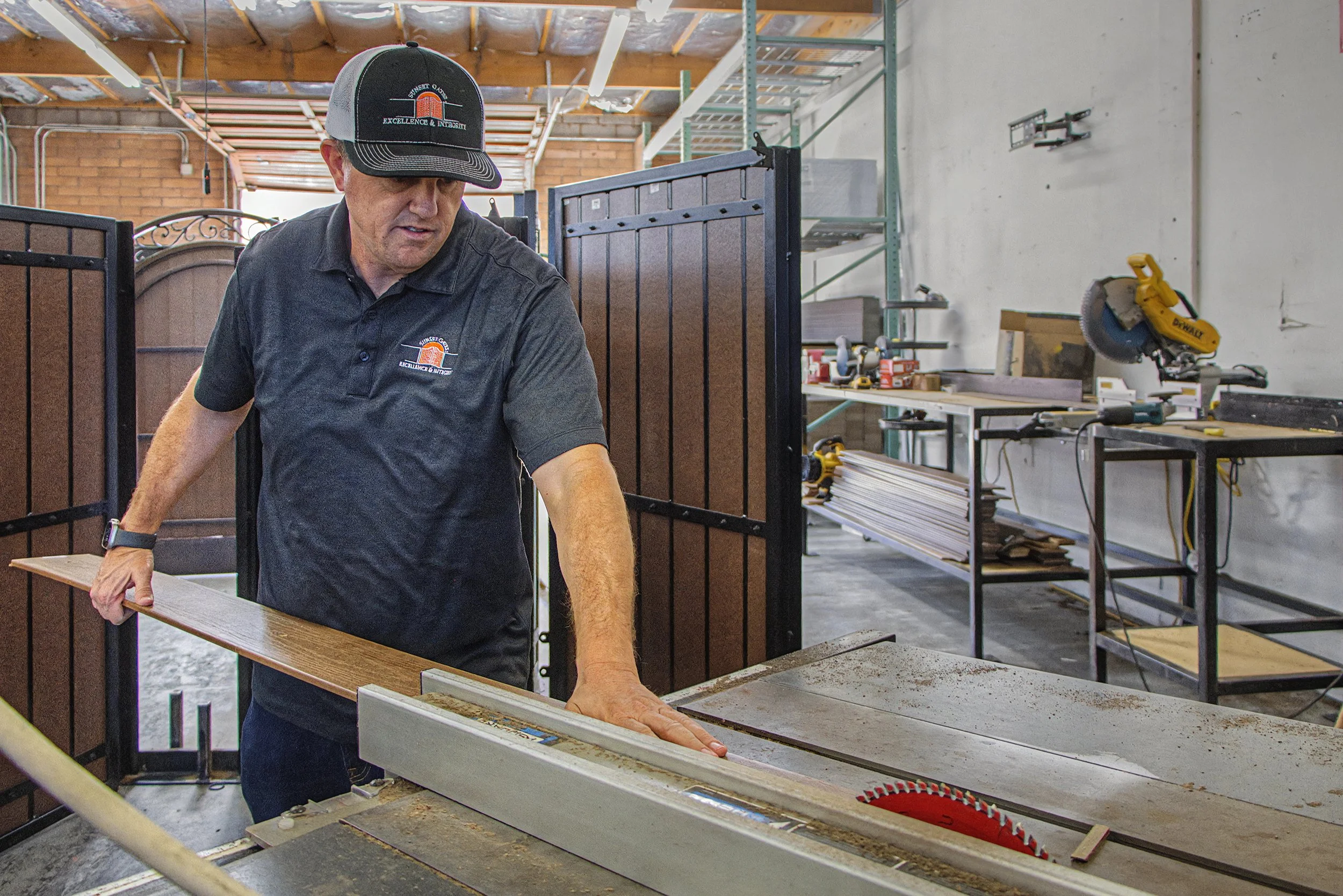
A fabricator works on a custom gate for an Arizona home.
The phrase 'custom fabrication' gets used loosely in the gate industry. Some companies use it to mean they will cut a stock panel down to size or weld a few extra inches onto a prefab frame. That is not custom fabrication. That is adaptation, and the results show it — in fit gaps at the posts, in hardware that is never quite right for the gate weight, and in a finished product that looks assembled rather than designed.
True custom gate fabrication means the gate does not exist until your project is confirmed. Every dimension is derived from your site measurements. Every design decision is made with your property's architecture in mind. Every component is selected and assembled for your specific application. In the Greater Phoenix metro — where properties vary enormously in style, lot size, opening dimensions, and soil conditions — this distinction matters enormously.
If you are considering a wrought iron gate for your home or commercial property in Tempe, Scottsdale, Mesa, Gilbert, Chandler, or the surrounding East Valley, here is what genuine custom fabrication involves and why it produces a fundamentally better result.
Why Custom Fabrication Exists
The practical reason for custom fabrication is simple: no two gate openings are the same. Opening widths vary. Heights vary. Post placement, ground grade, architectural style, vehicle clearance requirements, and homeowner design preferences all vary. A manufacturing process that produces gates to fixed dimensions cannot accommodate this variation without compromise.
Beyond dimensional fit, there is the question of design compatibility. A prefab gate in a standard ornamental pattern will fit some homes reasonably well and look completely out of place on others. Custom fabrication allows the gate design to be derived from the property rather than imposed on it — and that difference is visible from the street.
The Raw Materials: Steel Selection
Custom gate fabrication starts with steel selection. Not all steel used in gate fabrication is equal, and the choice of material affects both the structural performance and the longevity of the finished gate.
At Sunset Gates, we use steel specified for the demands of each application. Frame members, pickets, and decorative elements are selected based on the gate's design, its intended use frequency, its exposure conditions, and its weight requirements. Lighter decorative elements in a residential pedestrian gate call for different specifications than the frame members of a heavy-duty commercial access gate or an oversized driveway gate serving a large lot in Scottsdale or Paradise Valley.
Pro tip: Ask any gate company you are evaluating what gauge steel they use for gate frames and pickets. Thinner gauge steel costs less and is easier to work with, but deflects under load, degrades faster at weld points, and produces a gate that feels noticeably less substantial when you open and close it. The difference between adequate and quality steel is something you can feel on day one and see clearly five years in.
Layout and Cutting
With steel selected and site measurements confirmed, fabrication begins with layout and cutting. Frame members are cut to the precise dimensions required by your opening — not to the nearest standard size. Pickets are cut to uniform height and prepared for consistent spacing. Decorative elements are cut, shaped, or bent to the design specifications established during the consultation.
Precision at this stage is what makes installation straightforward rather than problematic. Gates cut to imprecise dimensions require shimming, bending, or on-site modification to fit — all of which compromise structural integrity and finished appearance.
Welding: Where Structural Integrity Is Made or Lost
Welding is the most skill-dependent part of gate fabrication, and it is where the difference between a quality fabricator and a marginal one is most apparent. Every connection in a wrought iron gate — frame joints, picket attachments, hinge reinforcements, decorative element attachments — is a welded joint, and every welded joint is a potential failure point if it is not done correctly.
Quality gate welding requires full penetration at structural connections, consistent bead profiles that resist cracking under the dynamic loads of repeated gate operation, and complete fusion at every joint without porosity or undercut. At Sunset Gates, welds at hinge points and frame corners — the highest-stress locations on any gate — receive additional attention and reinforcement.
Pro tip: After welding, weld beads on visible surfaces are ground smooth and blended to a finished profile. This is a finishing step that takes time but is essential to both appearance and corrosion resistance. A rough, unblended weld bead creates surface irregularities that trap moisture and accelerate rust formation — particularly relevant in Arizona's monsoon season when humidity spikes rapidly after months of dry conditions.
Decorative Elements and Ornamental Ironwork
For traditional ornamental gate designs, decorative elements — scrollwork panels, finials, spear tips, and similar details — are either fabricated in-house or sourced from quality suppliers and integrated into the gate during fabrication. The integration matters as much as the elements themselves.
Decorative components that are tack-welded superficially onto a finished frame feel and look different from those that are structurally integrated during the build. The former are prone to rattling, working loose over time, and creating areas of moisture entrapment at the weld points. The latter becomes part of the gate's structural fabric.
Frame Squareness and Dimensional Verification
Before a fabricated gate leaves the shop, it is checked for squareness, dimensional accuracy, and design conformance against the original specifications. A gate that is not square will not hang correctly, regardless of how well the site preparation was done. A gate that does not match the confirmed dimensions will not fit the opening without modification.
This verification step is straightforward but critical, and it is one that some fabricators skip in the interest of production speed. At Sunset Gates, every gate is checked before it leaves the facility.
Powder Coating: The Finish That Protects the Investment
After fabrication and final inspection, gates are powder-coated. Powder coating is the appropriate protective finish for wrought iron gates in the Greater Phoenix metro because it creates a chemically bonded, UV-resistant barrier that outperforms liquid paint in every relevant performance category — scratch resistance, impact resistance, UV degradation, and adhesion longevity under Arizona's thermal cycling conditions.
Color selection happens during the design consultation, and the powder coat is applied after all fabrication is complete. Any welding or grinding done after powder coating breaks through the protective finish and creates bare metal exposure — a quality control detail worth understanding when evaluating any fabricator.
Hardware Integration
Custom fabrication also means that hardware is specified and integrated for the specific gate being built. Hinge weld plates are positioned for the actual weight and swing geometry of the gate. Latch strike plates are located for the actual latch hardware being installed. Nothing is placed by approximation and adjusted later.
For gates installed by Sunset Gates on our own projects, hardware installation is part of the complete service. Hinges, latches, locks, gate stops, and drop rods for double gates are all installed by the same team that fabricated the gate, which means the people installing the hardware understand exactly what it is being attached to.
Why Arizona's Climate Makes Fabrication Quality Non-Negotiable
Fabrication quality matters everywhere, but it matters with particular urgency in the Greater Phoenix metro. Arizona's extreme heat, intense UV radiation, expansive soils, and monsoon moisture create conditions that expose every weakness in a gate's construction. Thin-gauge steel, inadequate welds, poor powder-coat adhesion, and undersized hardware all fail faster here than in more temperate climates.
A custom-fabricated gate built to appropriate specifications for Arizona conditions does not require this forgiveness. It performs reliably in the environment it was built for, which is exactly the point.
FAQs
-
True custom gate fabrication means the gate does not exist before your project is confirmed — every dimension derives from on-site measurements at your Tempe, Scottsdale, or East Valley property, every design decision is made with your specific architecture in mind, and every component is fabricated and assembled for your installation. Some Phoenix-area companies use "custom" to mean they will cut a stock panel to approximate size or add a decorative element to a prefab frame — that is adaptation, not fabrication, and the results in fit, appearance, and longevity reflect the difference
-
Steel is selected for the demands of each specific application in our Tempe fabrication shop. Frame members, pickets, and decorative elements are specified based on the gate's design, intended use frequency, weight requirements, and Arizona's climate exposure conditions. Commercial and estate gates for properties in Scottsdale, Paradise Valley, and larger East Valley lots receive heavier gauge specifications than standard residential gates — not a single residential template is applied regardless of application.
-
Every connection in a wrought iron gate is a welded joint, and every welded joint is a potential failure point under Arizona's conditions. Phoenix metro gates experience extreme thermal cycling, UV exposure, and monsoon-season moisture that stress weld connections over time. Quality gate welding requires full penetration at structural connections, consistent bead profiles that resist fatigue cracking under the dynamic loads of repeated operation, and complete fusion without porosity — particularly at hinge points and frame corners where stress concentration is highest.
-
Powder coating is applied after fabrication is fully complete at our Tempe shop — after all welding, grinding, and final inspection. The gate is coated as a complete unit, ensuring consistent film coverage across every surface, including edges, internal angles, and weld joints. We never weld on finished gates, and we never apply powder coat to partially fabricated assemblies requiring additional welding. This sequencing produces the complete, continuous protective film that protects custom iron gates across the Greater Phoenix metro from UV degradation, thermal cycling, and monsoon moisture.
-
Fabrication typically takes one to two weeks from confirmed specifications depending on design complexity. A standard residential gate with modest ornamental detail runs toward the shorter end of that range. An estate gate with elaborate scrollwork for a Scottsdale or Paradise Valley property, or a multi-panel commercial gate for a Mesa or Chandler installation, may run toward the longer end. We communicate the fabrication timeline clearly in the written proposal and do not rush production to meet arbitrary deadlines at the expense of quality.
Serving the Greater Phoenix Metro
Sunset Gates handles custom iron gate fabrication for residential and commercial clients throughout Tempe, Mesa, Scottsdale, Gilbert, Chandler, Phoenix, Paradise Valley, Ahwatukee Foothills, Fountain Hills, Glendale, Sun Lakes, Queen Creek, and Apache Junction. Every gate we install is fabricated by our own team — we do not outsource fabrication.
Contact Sunset Gates to schedule your free on-site consultation. We will assess your site, develop a design appropriate for your property and budget, and walk you through the complete fabrication and installation process before any work begins.