Pivot Point: How Custom Hinged Iron Gates Are Built for Decades of Daily Use in Arizona
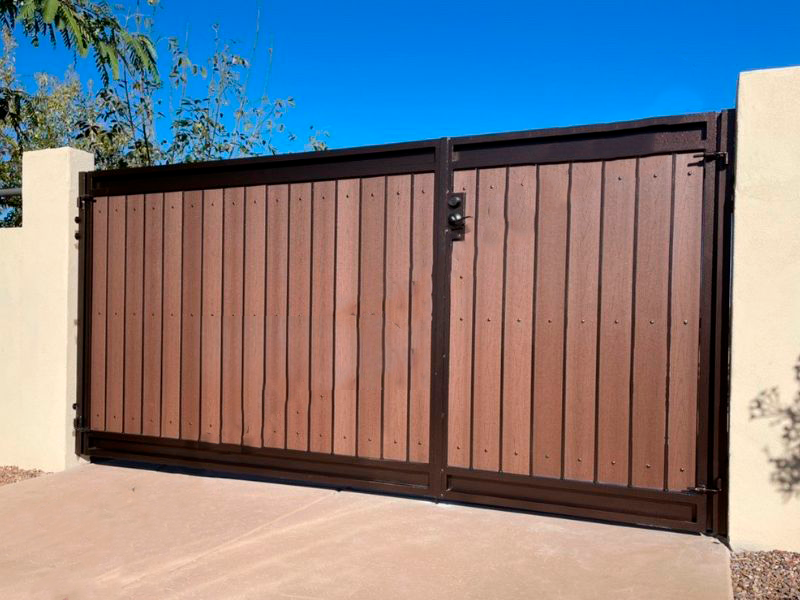
Manual driveway gates offer reliability, low maintenance, and timeless style.
A hinged gate that starts squealing six months after installation is not a noise problem. It is a symptom of a hinge that was not rated for the load it is carrying, and that squeal is telling you that the bearing is wearing down faster than it should. By the time most homeowners in the Phoenix metro area get around to doing something about it, the hinge has developed enough play that the gate is no longer hanging true, the latch is misaligned, and what started as an annoying sound has become a full mechanical problem. The hinge is the pivot point of the entire system, and when it is specified incorrectly or installed without attention to the load it will carry, everything downstream suffers.
Custom hinged iron gates are the most common gate configuration across residential and commercial properties in the Phoenix metro area, and the hinge system is what determines whether a gate performs like a precision piece of hardware for decades or becomes a recurring source of frustration within a few years. The conversation about hinges is rarely the exciting part of a gate project, but it is the part that most directly determines the long-term outcome. Understanding how custom hinged gates are engineered, specified, and installed is what allows homeowners and property owners to make informed decisions that they will not regret five years down the road.
How Hinge Selection Actually Works
Hinge selection for a custom iron gate is an engineering decision, not an aesthetic one. The primary variables are gate weight, gate width, and use frequency, and all three need to be assessed accurately before a hinge is specified. A gate that is heavier than the hinge will wear the bearing quickly, leading to the play and sag that makes a gate feel loose and look crooked. A gate that is used more frequently than the hinge was designed for will reach the same condition faster. Getting this calculation right from the start is what separates a hinge specification that performs for twenty years from one that needs replacement in five.
Ball-bearing hinges are the standard specification for wrought iron gates because the ball bearing allows smooth rotation under load without the metal-on-metal friction that causes standard butt hinges to wear and seize. For heavier gates, agricultural-rated weld-on hinges with larger bearing surfaces distribute the load more effectively and are appropriate where gate weight exceeds what residential-grade hardware is designed to handle. The number of hinges on the gate matters as much as the specification of each individual hinge. Lightweight pedestrian gates need two hinges, generally speaking. Three hinges on a heavier or wider gate reduce the load at each hinge point and significantly extend the service life of all three. For very heavy gates or gates in high-use commercial applications across Phoenix, AZ, four hinges may be the correct specification.
What Custom Means in the Context of Hinged Gate Fabrication
When a gate is described as custom, it means the design, dimensions, material specification, and hardware selection are all developed for that specific gate and that specific installation. In the context of hinged iron gates, custom fabrication starts with measuring the actual opening, assessing the post conditions, understanding the use pattern of the gate, and then designing a gate that is appropriately sized and proportioned for the opening it will occupy. None of that can happen with a prefabricated gate that is selected from a standard size range, because the standard size range was not developed with your opening in mind.
Custom fabrication also means that the structural elements of the gate, the internal frame, the diagonal bracing that prevents the gate from racking over time, and the reinforcement at the hinge attachment points, are designed and built for the specific weight and dimensions of that gate. A wider gate needs more internal bracing than a narrow gate. A heavier design with dense scrollwork needs more robust hinge attachment than a simple flat bar gate. These structural decisions are made during fabrication, not during installation, and a fabricator who does not think through them during design is producing a gate that will be corrected in the field, if the installer catches the problem, or left to underperform if they do not.
Post Conditions and Why They Determine Everything Else
The best hinge specification in the world cannot compensate for posts that are not set correctly. The hinge transfers the weight and movement of the gate into the post, and the post transfers those forces into the ground. If any link in that chain is inadequate, the gate will eventually drift out of alignment as the structure gives under the accumulated load. For homeowners in the Phoenix metro area, the soil conditions add a layer of complexity to this calculation that does not exist in regions with more stable soils. Expansive clay soils, which are present in many Phoenix-area neighborhoods, can move significantly as they cycle through wet and dry states, and that movement directly affects posts that are not set deep enough.
A professional hinged gate installation begins with an assessment of the existing post conditions before any installation work starts. If the existing posts are sound and appropriately sized for the gate being installed, the installer proceeds with hanging the gate. If they are not, replacing the posts before hanging the new gate is the correct sequence, not an optional upgrade. Homeowners who are told that their existing posts are fine when a site assessment has not actually been done should treat that assurance with skepticism. Post failure is the most common reason that a well-fabricated gate installed by an experienced crew still underperforms, and it is almost always because someone assumed the posts were adequate rather than verifying it.
Daily Use Patterns and What They Do to a Hinged Gate
A front entry gate used twice a day experiences very different cumulative stress than a commercial gate used thirty or forty times a day. Over the course of a year, that difference in cycle count translates into a factor of fifteen or twenty in terms of wear on hinges, latch mechanisms, and hinge-side post loading. Custom hinged gates built for commercial applications across Phoenix, AZ, need to be specified to a different standard than those built for residential use, not because the design language needs to be different, but because the mechanical components need to be rated for the actual use pattern rather than a residential assumption.
Even within residential applications, use patterns vary enough to matter. A pool gate that is used by children throughout the day has a very different cycle count than a front entry gate used by adults who drive rather than walk. A side yard gate used to access equipment storage may be used infrequently, but it is subjected to more lateral force than a gate in a more protected location. Sunset Gates approaches each custom hinged gate project by asking about actual use patterns before specifying hardware, because a gate built to the right spec for its actual life in the field performs better and requires less maintenance than one built to a generic residential standard that may or may not match the reality of how the gate gets used.
The Role of Welding Quality in Long-Term Performance
Welding quality in a custom hinged gate affects both the structural performance and the visual quality of the finished piece, and the two are more connected than most homeowners realize. In the structural dimension, the welds at the hinge attachment points are the most critical because those welds transfer the full weight and movement of the gate into the frame at every cycle. A weld that is undersized, poorly fused, or positioned incorrectly at a hinge attachment point will eventually crack under the cumulative fatigue load, and a cracked weld at a hinge point is a gate that has suddenly lost its structural integrity at the most critical connection in the system.
The visual dimension of welding quality is particularly important in custom decorative ironwork, where welds at scrollwork intersections, collar placements, and rail connections are visible at close range. Ground smooth and dressed correctly, these welds are invisible in the finished gate. Left rough or with burn marks, they read as low-quality fabrication regardless of how well everything else in the gate was executed. In the Phoenix metro area, where homeowners invest significantly in the visual quality of their property's exterior, a gate that is structurally sound but visually rough is not a successful outcome.
FAQs
-
The clearest signs that hinges need attention are audible squealing or grinding during operation, visible play or wobble in the gate when it is moved, a gate that no longer hangs level or has developed a noticeable lean, and a latch that no longer aligns correctly with the strike plate, even though the posts appear to be in their original position.
-
Residential-grade hinges are rated for gate weights and cycle counts appropriate for standard home use, typically lighter gates used a limited number of times per day. Commercial-grade hinges are built with larger bearing surfaces, higher load ratings, and materials specified for higher cycle counts and heavier gate weights. For residential gates that are heavier than average or used more frequently than typical, commercial-grade hinges are sometimes the right specification even on a home property.
-
Yes, in most cases, hinge replacement or upgrade is possible on an existing gate without replacing the gate itself. The process involves removing the gate from the existing hinges, welding new hinge plates or hinge bodies to the gate frame and the post, and rehinging the gate on the new hardware. Whether the existing post is adequate for the new hinge specification is an important part of this assessment, because upgrading to a heavier hinge on a post that is not sound will not produce the expected result.
-
The Phoenix metro climate is challenging for exterior hardware because of the combination of sustained high heat, intense UV exposure, and the wet-dry cycling of seasonal rains. Hinges that are not made from corrosion-resistant materials or that have not been adequately finished will develop surface rust that eventually compromises the bearing function.
-
Look for a fabricator who asks about gate weight, use frequency, and site conditions before specifying hardware, because those questions indicate that they are engineering the gate rather than just building to a standard template. Ask to see examples of completed hinged gate projects, and pay particular attention to whether the gates are hanging level and operating smoothly. Ask about the hinge specification and the reasoning behind it.
Serving the Greater Phoenix Metro
Sunset Gates installs custom manual driveway gates throughout Tempe, Mesa, Scottsdale, Gilbert, Chandler, Phoenix, Paradise Valley, Ahwatukee Foothills, Fountain Hills, Glendale, Sun Lakes, Queen Creek, and Apache Junction. Every gate is custom-fabricated at our Tempe shop and installed by our own team.
Contact Sunset Gates for a free on-site estimate. We will assess your driveway, discuss your configuration options, and give you complete, transparent pricing — so you can make an informed decision about the right gate for your property.