Measure First, Install Once: Why On-Site Gate Measurement Matters in the Phoenix Metro
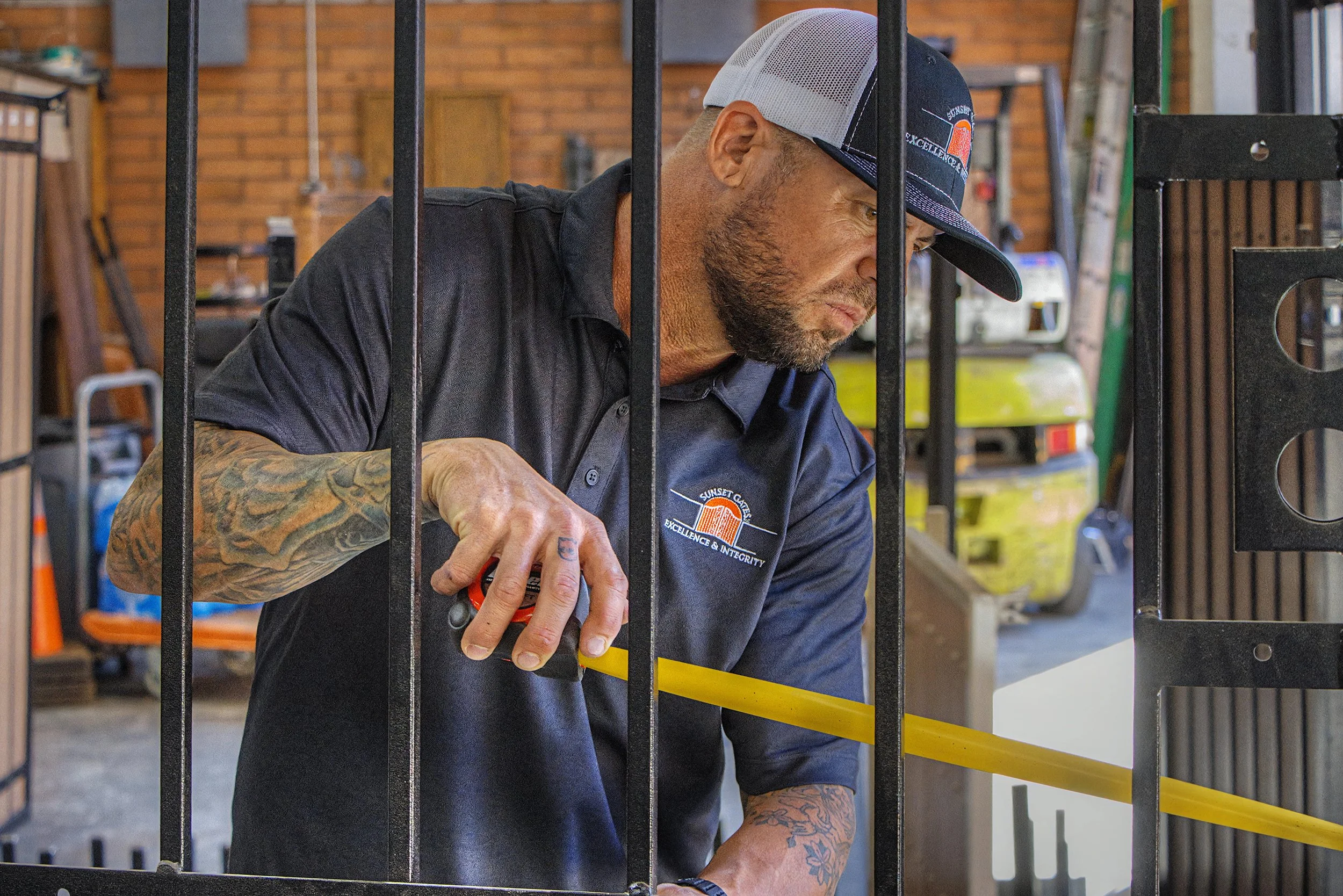
A dedicated professional at work on a gate installation in Phoenix metro.
There is a version of gate installation that goes like this: a homeowner provides a rough opening width over the phone, a gate is fabricated to that number, it arrives on installation day, and nothing about it fits quite right. The opening is wider at the bottom than at the top. The ground slopes across the entry in a way no one accounted for. The existing block pillars are not plumb. The hinge locations assumed by the fabricator do not match the pillar dimensions.
Everything that follows is a series of compromises: shimming, bending, cutting, and field-welding. The gate gets hung, but it does not hang correctly. The latch does not engage cleanly. There is a gap at one post and a bind at the other. Within a year, it starts to sag.
This is not a rare scenario. It is what happens when gate installation begins with inadequate measurement — and it is entirely preventable. For homeowners in Tempe, Gilbert, Chandler, Mesa, Scottsdale, and across the Greater Phoenix metro, understanding why professional on-site measurement matters is the first step toward a gate installation that works correctly from the first day and continues working for decades.
Why Opening Dimensions Are More Complex Than They Appear
The instinct to measure a gate opening is to measure the width between the two posts or pillars at one point — typically at standing height — and call that the gate dimension. In practice, that single measurement misses most of the information that matters.
Openings Are Rarely Uniform
Block pillar construction in the Phoenix metro is subject to the same thermal expansion and soil movement forces as everything else in Arizona's climate. Pillars that were plumb when installed shift incrementally over the years of heat cycling and soil movement. A pillar that appears perfectly upright can be out of plumb by a quarter inch or more — enough to create a meaningful difference between the opening width at the top and the opening width at the bottom.
When a gate is fabricated to a single width measurement taken at one height, it fits correctly at that height and is either too wide or too narrow at every other point. The result is binding, dragging, or an unacceptable gap at the latch point.
Ground Grade Affects Gate Design
Very few residential driveway openings in the Phoenix metro have perfectly level ground across the full opening width. Driveways slope toward the street for drainage. Landscaping grades change over time. Previous concrete or paving work creates elevation transitions at the gate entry.
A gate fabricated without accounting for ground grade will either scrape the high side of the opening or have an unacceptable gap at the low side — or both, if the grade changes direction across the opening. Addressing grade in the design phase means building the gate with appropriate clearance geometry before it is ever installed, not discovering the problem on installation day.
Pro tip: In Arizona, ground grade at gate openings changes more than most homeowners expect over a property's life. Soil settlement, tree root growth, landscaping updates, and driveway repaving all affect grade at the entry point. When we measure for a new installation or replacement, we assess the current grade and account for it explicitly in the gate design — not as a correction but as a planned dimension.
Existing Structure Condition
The condition of existing gate posts or block pillars is a critical variable in any installation that uses those structures as hinge anchor points. A pillar that has deteriorated mortar, cracked cores, or improperly reinforced interiors cannot reliably support the dynamic load of a gate swinging on hinges attached to it, regardless of how well the gate is fabricated.
Assessing the existing structure condition requires physical inspection. You cannot determine whether a block pillar is structurally sound from a photograph or a verbal description. You can tap it, probe the mortar, check it for plumb with an accurate level, and look for evidence of previous movement or repair. That assessment informs whether the existing structure can be used as-is, needs modification, or needs to be replaced — and that decision has significant implications for the project budget and scope.
What Professional On-Site Measurement Covers
At Sunset Gates, the on-site measurement visit is a full site assessment, not a quick width check. We evaluate:
Opening width at multiple heights — top, middle, and bottom — to identify any taper or non-uniformity in the opening
Opening height at both hinge-side and latch-side post locations
Ground grade across the full opening width, measured precisely.
Post or pillar plumb on both sides of the opening
Condition of existing posts or pillars — structural integrity, mortar condition, evidence of movement
Existing hinge anchor locations and conditions for reusing existing hardware attachment points
Available swing clearance on the entry side of the gate — whether inward or outward swing is appropriate, given vehicle parking, landscaping, and grade
Any surface features — irrigation lines, electrical conduit, drainage structures — in the post zone
This information goes directly into the fabrication specifications and the site preparation plan for the project. Every dimension in a Sunset Gates fabrication drawing comes from on-site measurement, not from homeowner-provided numbers.
Why Photos and Homeowner Measurements Are Not Enough
We regularly receive inquiries from homeowners who want to provide their own measurements and photos and receive a firm quote without a site visit. We understand the appeal — it is faster and more convenient. We do not offer this service, and the reason is straightforward: the variables that most affect gate performance are not visible in photos and cannot be accurately captured by a homeowner with a tape measure.
Pillar plumb, ground grade, soil conditions at post locations, the structural integrity of existing concrete or masonry, and the precise three-dimensional geometry of the opening all require physical assessment. A quote based on homeowner-provided dimensions is a quote based on incomplete information — and any fabrication that follows from it is a gamble.
Pro tip: If a gate company offers a firm price quote based solely on dimensions you provide over the phone or by email, treat that as a warning sign. Either they are planning to adapt whatever they have in stock to fit your opening — not custom-fabricating for your site — or they are planning to discover the real site conditions on installation day and address them at additional cost. Neither approach serves your interests.
Measurement as the Foundation of the Design Conversation
The on-site measurement visit serves a purpose beyond data collection. It is also the most productive context for the design conversation about your gate.
Standing at the actual opening, with the actual pillars, the actual house, and the actual landscape visible, is the best possible environment for discussing gate style, proportions, swing direction, hardware placement, and finish. Design decisions that might seem arbitrary in the abstract become obvious in context — because you can see exactly how the gate will read against the home, how it will interact with the existing hardscape, and how it will function given the real geometry of the site.
The Cost of Getting Measurement Wrong
Measurement errors have costs that extend well beyond the inconvenience of a gate that does not fit on installation day. A gate fabricated to incorrect dimensions must either be modified — which compromises the weld integrity and finish of the fabrication — or remade. On-site field modifications are rarely clean, and they are visible. A gate that has been cut, bent, and field-welded to fit an opening it was not made for does not look like a gate that was made for that opening.
Beyond the immediate fabrication issue, a gate that does not fit correctly places uneven stress on its hardware. Hinges that are working against misalignment wear faster. Latches that do not engage cleanly are forced and eventually fail. The long-term maintenance cost of a poorly fitted gate is meaningfully higher than the upfront cost would suggest.
FAQs
-
The variables that most affect gate performance in the Greater Phoenix metro — block pillar plumb deviation, ground grade changes across the opening, soil conditions at post locations, and the three-dimensional geometry of the entry zone — cannot be accurately captured by a homeowner with a tape measure. In the Phoenix area, block pillars commonly show measurable taper from thermal cycling and soil movement, and grade changes at driveway entries are nearly universal. A gate fabricated from homeowner-provided dimensions is a gate fabricated from incomplete information, which shows up as fit and alignment problems on installation day.
-
Grade changes across a driveway opening in the East Valley directly affect the gate's bottom rail clearance profile — the shape of the gate's lower edge as it swings through its arc. A gate designed without accounting for the specific grade at a Mesa, Chandler, or Gilbert driveway entry will either scrape the high side of the opening or leave an unacceptable gap at the low side. We measure grade precisely during every on-site evaluation and incorporate it into the fabrication specification so the finished gate clears correctly without field modification.
-
During on-site measurement visits across Tempe, Mesa, Scottsdale, Chandler, Gilbert, and the broader East Valley, we measure opening width at multiple heights to identify taper, assess ground grade precisely across the full opening width, check post or pillar plumb on both sides, evaluate the structural condition of any existing posts or block pillars, probe for caliche at post locations, assess available swing clearance on both sides of the opening, and identify any regulatory or HOA setback requirements applicable to the specific site.
-
Gates fabricated to inaccurate measurements require field modification — cutting, bending, shimming, or on-site welding — to fit the opening. These modifications compromise structural integrity and finished appearance in ways that are visible and permanent. Beyond the immediate installation problem, a gate that does not fit correctly stresses its hardware unevenly, causing hinges and latches to wear faster and alignment problems to worsen progressively. For Phoenix metro homeowners in Tempe, Scottsdale, or the East Valley, the cost of measurement errors compounds over the life of the installation.
-
No. On-site measurement and design consultation is provided at no charge for residential and commercial properties throughout our Greater Phoenix service area, including Tempe, Mesa, Scottsdale, Gilbert, Chandler, Phoenix, Paradise Valley, Ahwatukee Foothills, Fountain Hills, Glendale, Sun Lakes, Queen Creek, and Apache Junction. The consultation produces a complete written proposal covering all project scope, specifications, and pricing — with no obligation to proceed.
Serving the Greater Phoenix Metro
Sunset Gates provides professional on-site measurement and site assessment for every gate installation project throughout Tempe, Mesa, Scottsdale, Gilbert, Chandler, Phoenix, Paradise Valley, Ahwatukee Foothills, Fountain Hills, Glendale, Sun Lakes, Queen Creek, and Apache Junction.
Contact Sunset Gates to schedule your free on-site measurement and consultation. We will assess your site thoroughly, give you accurate information about your specific conditions, and provide a complete, transparent proposal before any fabrication begins.