Commercial Projects Need Commercial-Grade Gates: Custom Iron Fabrication for Phoenix Businesses
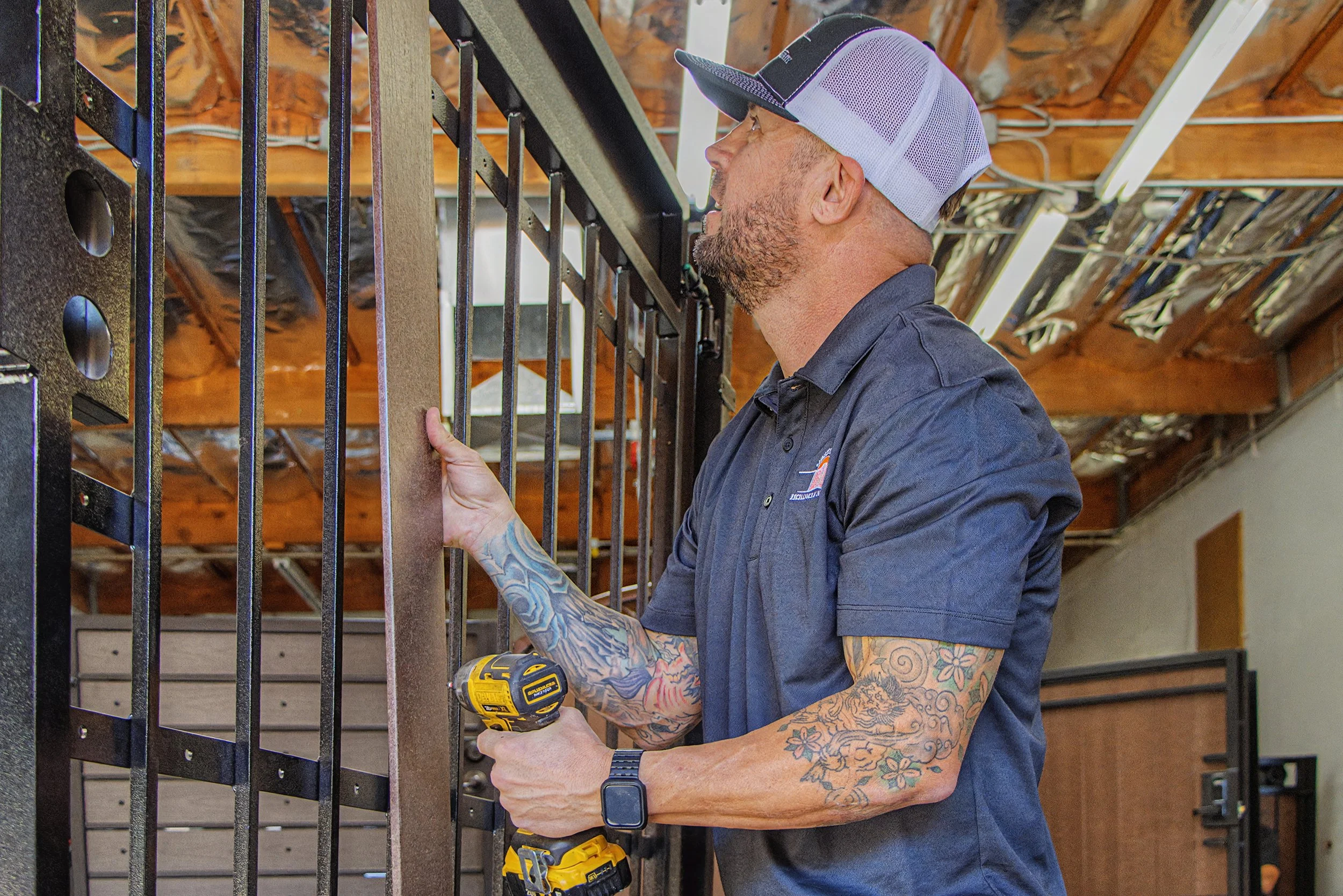
A dedicated professional at work on a gate installation in Phoenix.
A commercial gate project is not a residential project with a bigger budget. The specifications are different, the timeline pressures are different, the code requirements are different, and the consequences of getting it wrong are different. A gate that underperforms at a private home is an inconvenience for one household. A gate that underperforms at a commercial property is a problem for every employee, every customer, every delivery driver, and every property manager who deals with it, every day, until it gets fixed. Phoenix-area businesses and contractors who have tried to address commercial gate requirements with residential-grade fabricators tend to arrive at the same conclusion: the short-term savings are not worth the long-term cost of a gate that was not built for the application.
Custom iron fabrication for commercial projects in the Phoenix metro area covers a wide range of applications, from office complex entry gates and retail property enclosures to industrial yard gates, school campus access points, and hospitality property entries. Each of these applications has specific requirements that affect the design, material specification, hardware selection, and installation approach, and none of them are well-served by a fabricator who treats commercial work as residential work at a larger scale. Understanding what commercial-grade custom iron fabrication actually involves, and what distinguishes the contractors who do it well from those who do not, is what allows commercial clients to make sourcing decisions that produce reliable outcomes rather than expensive corrections.
How Commercial Specifications Differ From Residential
The specification differences between commercial and residential iron gate fabrication begin with material gauge and compound from there. Commercial applications typically involve heavier vehicle traffic, higher cycle counts, larger opening widths, and more exposure to incidental impact from vehicles, equipment, and delivery activities than residential applications face. Each of these factors drives a specification choice. Heavier gauge frame sections resist the racking and deformation that repeated high-force operation causes over time. Larger hinge hardware, rated for the actual gate weight and cycle count, maintains bearing function through the millions of cycles a commercial gate may experience over its service life. Latch and lock hardware at the commercial level is specified for both security and operational durability, not just one or the other.
Building code requirements for commercial gate installations in Phoenix, AZ, add another layer of specification that does not apply to residential work. Fire department access requirements, egress provisions that govern how gates must operate in emergency situations, accessibility standards for gates serving public-facing entries, and setback and sight-line requirements that vary by zoning classification all affect the design of a commercial gate in ways that have nothing to do with aesthetics and everything to do with regulatory compliance. A fabricator who does not understand these requirements will produce a gate that may need to be redesigned, modified, or removed after installation, which is a cost and a disruption that commercial clients cannot afford on active properties.
Timelines and Coordination in Commercial Gate Projects
Commercial construction and renovation projects operate on schedules where gate installation is one component in a sequence of trades, and a gate that is not delivered and installed on schedule creates downstream problems for the general contractor and the property owner. The fabrication lead time for a custom commercial iron gate needs to be established at the beginning of the project and managed through the fabrication process so that delivery aligns with the site readiness and the installation window in the overall construction schedule. A fabricator who cannot provide a reliable lead time estimate, or who treats commercial project timelines as approximate rather than binding, is not a viable partner for a project where schedule adherence matters.
Coordination with other trades is another dimension of commercial gate work that does not exist in residential projects. The electrical rough-in for gate automation needs to be completed before the gate operator is installed. The masonry or concrete work at the gate post locations needs to cure before the gate is hung. The site access that the installation crew needs may conflict with other active work on the site, requiring coordination with the general contractor or site superintendent. Sunset Gates approaches commercial gate projects with a project management orientation that accounts for these coordination requirements because delivering a well-fabricated gate to a site that is not ready for it, or being ready to install on a date when the site is unavailable, adds cost and delay that commercial clients are right to hold their contractors accountable for avoiding.
Design Flexibility Within Commercial Specifications
Commercial-grade fabrication does not mean uniform or generic design. The structural and specification requirements of a commercial gate establish a performance floor, not a design ceiling, and within those requirements, there is significant room for custom design that reflects the architectural character of the property and the branding or identity of the business. An office complex entry gate in Scottsdale, AZ, that needs to meet commercial-grade structural specifications can still be designed in a clean contemporary style that complements the building's architecture. An industrial yard gate that needs to withstand daily contact with heavy vehicles can still incorporate design elements that present the property professionally from the street.
The design conversation for a commercial gate project should include all of the stakeholders who will care about the outcome: the property owner or developer who cares about the long-term performance and maintenance cost, the architect or designer who cares about architectural consistency, the general contractor who cares about schedule and coordination, and sometimes the end user or tenant who cares about daily operational convenience. A fabricator who can participate in that design conversation as a technical resource, offering specific fabrication knowledge that informs design choices rather than simply accepting a drawing and executing it, produces better outcomes than one who treats design as the architect's problem and fabrication as their own separate domain.
Material and Finish Standards for Commercial Phoenix Projects
The material and finish standards for commercial iron gate fabrication in Phoenix, AZ, reflect the extreme climate conditions that exterior metalwork faces in this region. Summer temperatures that routinely exceed a hundred and fifteen degrees, UV irradiance among the highest in the continental United States, and the wet-dry cycling of the seasonal rains create a testing environment for exterior coatings that eliminates lower-quality finish systems within a few years of installation. Commercial properties that invest in custom iron gates need those gates to maintain their appearance and structural integrity for a decade or more without requiring refinishing, and achieving that requires a finish system that is specified and applied correctly from the start.
The correct finish system for commercial exterior ironwork in the Phoenix metro area begins with surface preparation that removes mill scale, fabrication residue, and any existing surface contamination down to bare metal. A primer coat appropriate for the substrate and the topcoat system is applied before the final powder coat color, and the powder coat is applied and cured under controlled conditions that the material manufacturer specifies for the product. Shortcuts in any of these steps, particularly in surface preparation, produce a finish that may look correct at installation but will fail prematurely, usually beginning at welds and edges where preparation is hardest and where coating adhesion is most dependent on thorough surface treatment. Commercial clients who specify finish quality as part of the project requirements, rather than accepting whatever the fabricator's standard process produces, get better long-term results.
What to Expect From a Commercial Gate Fabrication Partner
A commercial gate fabrication partner for Phoenix-area projects should be able to demonstrate experience with commercial-scale projects before being awarded work. That demonstration should include specific examples of completed commercial installations, references from general contractors or property owners who can speak to schedule adherence and installation quality, and a clear explanation of how the fabrication shop manages commercial project requirements differently from residential work. Fabricators who position their residential work as sufficient preparation for commercial projects without specific commercial experience are a risk that experienced project managers recognize and avoid.
The relationship with a commercial gate fabrication partner should include clear communication at each project milestone: design approval, permit submission, fabrication start, fabrication completion and delivery, and installation completion with final inspection. Commercial clients who are managing multiple trades and multiple deadlines on a project need to know that the gate is on track or off track at each of these points, not find out at delivery that a problem occurred two weeks earlier. A fabricator who manages client communication as an active part of project delivery rather than a reactive response to client inquiries is operating at the level that commercial projects require. Sunset Gates structures commercial project communication around these milestones because the clients who engage for commercial work are managing complex projects where information gaps create real downstream problems.
-
Custom commercial iron gate fabrication serves a wide range of property types across the Phoenix metro area, including office complexes, retail centers, industrial and warehouse properties, multifamily residential communities, hospitality properties, educational campuses, healthcare facilities, and municipal or institutional properties.
-
Commercial gate installations in Phoenix, AZ, typically require building permits and may involve plan review by the building department, fire department, and, in some cases,s the city planning department if the project affects the property's street presentation or involves changes to an approved site plan. The permit process for commercial projects is generally more involved than for residential installations and requires complete construction documents that show the gate design, dimensions, materials, hardware, and post-installation details.
-
Yes. Custom fabrication means the gate design is developed specifically for the project rather than selected from a catalog, which allows the design to be calibrated to the architectural character, material palette, and color scheme of the existing property. Whether the property uses a traditional Mediterranean design vocabulary, a contemporary commercial aesthetic, an industrial character, or something in between, the gate design can be developed in response to those cues.
-
A complete commercial gate quote requires the opening dimensions, including width, height, and any height constraints from overhead structures, the fence or wall material and construction the gate will integrate with, the intended use pattern including vehicle types and estimated daily cycle count, the access control requirements including whether key, fob, or code entry is needed, any code or regulatory requirements you are aware of for the property type, and the project timeline including the target installation date and any upstream dependencies that affect when the gate needs to be complete.
-
Evaluate competing bids on the completeness of what each bid includes, not just the bottom-line price. A lower bid that excludes permit fees, post replacement, or site preparation that the project actually requires is not a lower-cost option. It is an incomplete scope that will generate change orders. Look for bids that specify the material gauge, hinge hardware rating, latch hardware model, finish system, including surface preparation process, and post specification in enough detail to confirm that the specification matches the project requirements.