
Custom vs. Off-the-Shelf Iron Gate: Which One Lasts?
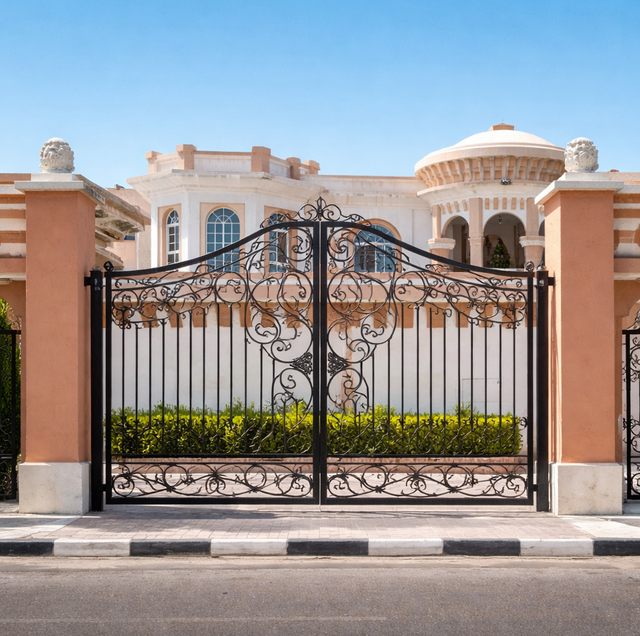
Quick Answer: An off-the-shelf iron gate comes in stock sizes, styles, and hardware, and works well for a standard, level opening on a tight timeline and budget. A custom gate is welded to your exact opening width, slope, weight, and style, which matters most for oversized or driveway spans, odd or sloped ground, style matching, and integrating an automatic operator. Fit and long-term reliability are where custom earns its keep.
You measured the opening, found a prefab iron gate online that looked close, and then paused. The width was almost right. The style was almost the style you wanted. And "almost" is exactly where iron gates start to cause problems, because a gate that binds, sags, or leaves a gap does it every single day for years.
The choice between an off-the-shelf gate and a custom-fabricated one is not really a choice between cheap and expensive. It is a choice about how much your specific opening and your specific use match what a factory built for an average one. Some openings are average. Plenty are not.
What "Off-the-Shelf" and "Custom" Actually Mean
An off-the-shelf, or prefab, gate is manufactured in batches to standard dimensions. A supplier stocks a range of widths and a handful of popular styles, and you pick the closest match. The panel arrives finished, you hang it on posts you supply, and you adapt the opening to the gate rather than the other way around.
A custom-fabricated gate starts from your measurements. A fabricator takes the opening width, the ground slope, the swing direction, the intended weight, the style you want, and the hardware you plan to run, then cuts and welds steel to those numbers. Nothing is "close." The gate is built to be the right size the first time.
The difference shows up in three places: how well the gate fits the opening, how it is put together, and how it holds up under years of daily swings.
When an Off-the-Shelf Gate Is the Right Call
Prefab is not a compromise everywhere. For the right opening, it is a sensible, faster answer.
The opening is standard and level: If your gap falls inside a common stock width and the ground on both sides sits at the same level, a prefab panel can drop in cleanly. Level ground is the quiet requirement here. A stock gate is built square, and square gates want flat, even openings.
The budget is tight, and the timeline is short: Prefab gates ship from existing inventory, so you skip the fabrication queue. When a gate needs replacing quickly, say a walk-through side gate that rusted through, a stock unit gets you a working gate in days rather than weeks. It costs less because the labor was spread across a production run, not spent on your one opening.
The gate is light-duty and pedestrian: A single-panel garden or side-yard gate that a person walks through carries far less stress than a wide driveway gate. Lighter loads forgive a lighter build. If nobody is driving through it and it is not spanning a long distance, a stock panel often holds up fine.
When Custom Fabrication Earns Its Keep
Custom is worth the extra time and cost when your situation pushes past what a stock gate was designed for. A few conditions make that call for you.
The opening is oversized, like a driveway or RV span: Wide gates are where prefab strains. A long span sags under its own weight over time unless the frame steel is heavy enough and the welds are placed to resist it. A fabricator sizes the frame gauge to the span and the leaf weight, so a 12- or 16-foot opening does not slowly droop and start dragging. RV-width openings for side-yard parking almost always land here.
The ground slopes or the opening is arched: Sloped driveways and openings that call for an arched or raked top are a poor fit for a square factory panel. A gate built for level ground on sloping terrain either scrapes the high side or leaves a gap on the low side. Custom fabrication rakes the bottom rail to the grade and shapes the top to the design, so the gate follows the land instead of fighting it.
You want the gate to match the house: Iron style is not one thing. Picket spacing, scroll and finial detail, rail placement, and overall proportion all read differently up close. A stock gate matches a catalog, not your entry. If you care about the gate looking like it belongs to the home rather than sitting in front of it, custom lets the fabricator match line and detail to what is already there.
You are integrating an operator or specific hardware: This is the one most people underestimate. An automatic operator has to be matched to the gate's weight and swing, and the hinges, latch, and posts have to carry both the gate and the forces the operator adds. A gate built with automation in mind gets the right hinge, the right pickup point, and posts set for the load. Retrofitting an operator onto a prefab gate that was never sized for it is where binding, premature wear, and safety problems start.
Build Quality Is the Real Divide
Fit gets the attention, but construction is where the two paths separate most.
Heavier prefab gates and most custom gates are welded steel, with the frame and pickets joined at every intersection so the panel behaves as one rigid piece. Lighter, lower-cost prefab panels can lean on fewer welds, thinner tube, or, in the cheapest cases, fasteners doing a weld's job. Thin-wall tube flexes, and flex is what works a finish loose and lets a gate rack out of square.
Finish is the other half. Iron rusts wherever the coating fails, and the coating fails first at edges, welds, and anywhere prep was rushed. A properly prepped and powder-coated gate resists corrosion far longer than a spray-painted one, especially where soil moisture reaches the base of the posts. Ask what the finish process is, not just the color.
When comparing gates, check the wall thickness of the frame steel and how continuously it is welded, since those tell you more about lifespan than the photo does. Ask what the finish process is, not just the color.
The Lead Time Trade-Off
The honest cost of custom is not only money, but it is also time. A stock gate can be in hand quickly. A custom gate has to be measured, drawn, cut, welded, finished, and cured before it hangs, which runs weeks rather than days.
That wait buys fit and durability. So the real question is whether your opening can accept a stock gate without workarounds. If it can, the speed of prefab is a genuine advantage, and you lose little by taking it. If your opening needs shims, filler panels, or a gate that "mostly" clears the slope, you are paying in daily annoyance and earlier repair for the time you saved up front.
Fit and Operation Are What You Live With
A gate is a moving part you touch constantly, so how it fits determines how it feels for years. A gate matched to its opening swings clean, latches on the first try, and clears the ground through its whole arc. A gate that is slightly off binds at one point, needs a lift to latch, or scrapes a spot in the driveway, and those small frictions wear hinges and hardware faster than the gate itself ages.
This is the quiet argument for custom on any opening that is not textbook. Reliability is not a feature you add later. It is decided the day the gate is sized to the space, or not.
Think of it like a door for a house. A pre-hung door fits a framed, standard rough opening beautifully and installs fast, but drop that same door into an out-of-square wall in an old house and it sticks, gaps, and never quite closes right. The fix is a door built to the opening you actually have. Iron gates work the same way.
A Safety Note Before You Buy or Build
A heavy driveway gate is not a light-duty product, and installing one is not a casual project. The posts and footings have to be sized and set to carry the gate's weight and the swinging load it puts on the hinges, or the whole assembly loosens over time. Structural setting and automation are pro work, not weekend work. And before any post hole is dug, call 811 so buried utilities are located and marked first.
A heavy automated gate can trap or crush whatever is in its path. The operator must be sized to the gate's weight and fitted with entrapment protection so it stops safely if something is in its way, and both the post setting and the automation are pro work, not weekend work.
How to Decide
Match the gate to the opening, not to the price tag. If your opening is standard, level, light-duty, and you need it soon, a well-built off-the-shelf gate is a reasonable buy. If your opening is wide, sloped, arched, style-sensitive, or destined for an operator, custom fabrication is where the gate actually fits, holds up, and keeps working. The extra lead time is the price of a gate you stop thinking about.
Frequently Asked Questions
Sometimes, within limits. A fabricator can add a filler panel beside a stock gate to close a modest width gap, or re-hang it to change swing direction. What generally cannot be fixed well is a raked bottom rail on a sloped opening, since that requires re-cutting the frame geometry, at which point you are paying custom labor on a gate that was not built for it. Narrowing a gate by cutting it usually means re-welding the outer stile, which can leave a weaker joint than a purpose-built frame.
Driveway gates typically use square structural tube in the frame rather than thin ornamental tube, because the frame carries the whole leaf. The heavier the leaf and the wider the span, the thicker the wall and the larger the tube section a fabricator specifies. There is no single number, since it scales with span and weight, but the frame tube on a driveway gate should be visibly heavier than the pickets it holds. A frame built from the same light tube as the infill is a warning sign.
A swing gate needs enough ground clearance to clear the highest point of its arc, since the bottom corner rises and falls as the gate opens on uneven ground. Too little clearance and it drags at that point, gouging the driveway and straining the hinges. Too much and pets or debris pass under, and a low rail no longer looks intentional. Getting this right on a sloped drive is one of the clearest reasons an opening ends up needing a custom-raked bottom.
No, the gate and operator have to be matched. Operators are rated for a maximum gate weight and length, and a leaf that exceeds the rating burns out the motor or fails to hold position in wind. The gate also needs a hinge and a solid pickup point positioned for the operator's arm or track. A prefab gate not designed for automation often lacks the reinforcement at the attachment point, which is why retrofits sometimes require adding a bracket or plate before the operator can be mounted safely.
They can if the weld area is not finished properly, because welds and edges are where a coating thins and rust starts. A good fabricator grinds welds smooth and ensures the finish covers them fully, since a rough or pinholed weld traps moisture. This is why finish prep matters as much as the weld itself. A gate with clean, ground, fully coated welds resists corrosion far better than one with rough beads left proud under a thin coat of paint, regardless of whether it was stock or custom.
Yes, and it is one of the common reasons people choose custom. A fabricator can pick up the picket spacing, top-rail height, and detailing of an existing iron fence, or set the gate to line up with block-pillar and block-wall construction, so the new gate reads as part of the original run. A stock gate rarely lines up on all three: spacing, height, and detail, at once, which is what makes a matched gate look built-in rather than added-on.
Get a free on-site measure of your exact opening — so your gate fits and swings right the first time. Sunset Gates serves Tempe and the East Valley. Call (480) 210-1572.
