
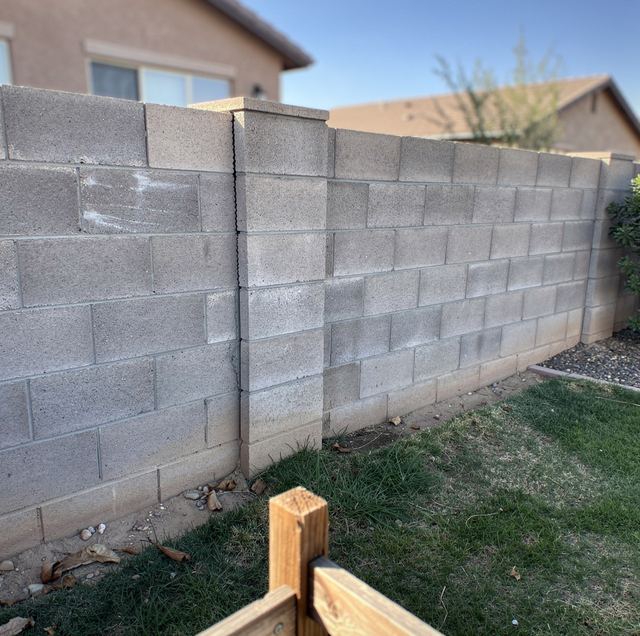
The block wall along your side yard has outlasted your irrigation timer, your last two vehicles, and your neighbor who helped build it. One of your sections leans now, and the mortar joints on your run have opened wide enough that you can see daylight through them from your patio.
You already know the wall is coming down. What you do not know is the rest of that day on your property: whether a saw is involved, where your rubble goes, how much of your yard turns into a work zone, how much of the wall you lose when only one part of it moved, and what your ground looks like.
An Old Block Wall Comes Apart the Way It Was Built
A block wall is not a stack of units on dirt. Concrete block is laid in running bond on mortar joints, certain vertical cells are filled with grout around a steel bar, and all of it bears on a continuous concrete footing below grade. The grouted cells and the footing turn a few hundred separate units into a single assembly, which is why an old wall behaves as a single object when the ground beneath it moves.
When a footing settles, or heaves, the wall above it opens along its weakest path, the mortar joint, and the crack climbs in stair steps up the run. Your leaning section is only the visible end of something that started well under the ground. That is also why a panel gets cut free rather than knocked apart: the grout and steel that made the wall one piece will drag the courses you meant to keep.
The Cut Line Comes Before Anything Comes Down
Saw cutting sits first on the service list for a reason. A vertical cut through the full thickness of the wall, placed at a pilaster or a grouted cell where the layout allows, separates the panel that leaves from the courses that stay. A wall broken instead of cut fractures on its own path, pulling block out of the section you were keeping and leaving a ragged edge where the new wall has to start.
Cutting is where the health risk sits, and its controls are well established. Guidance on cut-off saws for masonry describes two engineering controls: water applied to the blade through one or two nozzles, and local exhaust ventilation, a shroud around the blade hosed to an industrial vacuum with a HEPA filter. The water rate is specific enough to matter: roughly half a liter, about 17 ounces, per minute is what suppresses dust, since less water is not as effective and more water does not improve it.
Workplace safety rules specify what that dust does. Respirable crystalline silica is created when cutting, sawing, grinding, drilling, and crushing stone, rock, concrete, brick, block, and mortar, and workers who inhale it are at increased risk of silicosis, an incurable lung disease that can lead to disability and death, lung cancer, chronic obstructive pulmonary disease, and kidney disease. Every verb there belongs to your demolition day.
Cutting block dry fills the air with respirable crystalline silica, so a wall is cut wet or with dust extraction and full respiratory protection by a crew already equipped for that work.
Whether the Wall Carries Anything Changes the Order of the Work
Not every block wall is doing the same job. A freestanding screen wall between two yards carries its own weight and whatever the wind pushes against it. A retaining wall holds back soil, and you can usually tell, because the grade is higher on one side than the other and weep holes appear along the bottom course. A third case sits between the two: a pilaster carrying a gate, where the post and its footing are structural, and the panels beside them are along for the ride.
The difference matters the moment a section comes out. A screen wall loses a panel, and the rest of the run keeps standing. A retaining wall loses a panel, and the soil behind it starts moving toward the opening, so a demolition question becomes a stability question. Have your wall assessed before any section is removed, because a retaining or shared wall can collapse on itself once a panel is removed.
Demolition, Removal, and Disposal Are Three Separate Operations in One Day
The three words on a service list are three separate operations, and only the first is loud. The other two determine what your property looks like when your crew leaves.
Demolition takes the isolated panel down in courses from the top, so nothing above the working line is left unsupported. Where a grouted cell or a bond beam crosses the cut, the steel inside it is cut through instead of pulled, because pulling a bar drags the courses it is still bonded to. The block comes down into pieces small enough to be handled, which is a deliberate choice: a full-height panel dropped in one go breaks where it wants and throws material farther than a controlled takedown does. What lands on the ground is then a pile, and a pile of block and mortar is far heavier than it looks.
Removal and disposal are listed separately, and both are the contractor's responsibility. Demolition covers "removing old or damaged wall sections cleanly before new construction begins," and wall removal covers "full removal of existing block, including disposal." The pile leaving is inside the scope, so your yard is not left holding it and your next trade is not working around it.
Irrigation, Lighting, and Gate Power Run Along the Same Wall Line
A wall line is a convenient place to run other things, and whoever built your yard probably used it. Irrigation mainline and valve wire follow the base of a wall because the trench was already open. Low-voltage yard lighting takes the same route. Gate power and intercom conduit reach the posts along it.
None of that is visible from either face, and a demolition saw cuts poly line as readily as mortar. Locating irrigation, low-voltage lighting, and gate power before the first cut turns a possible second job into a line on your scope sheet.
Who Needs to Agree Before a Shared Property-Line Wall Comes Out?
Some block walls stand entirely on one property, and some sit on the line between two. The difference is not something you resolve with a tape measure on the morning of demolition, and it is not a construction question at all. A wall on or near a property line, or one that two households have treated as shared for years, must be agreed to with your neighbor and the city before the work is scheduled. That conversation belongs at the front of your project, well before a crew is booked.
The permitting side has its own written path. The service list names permit pulling as part of the work, described as handling the permitting process with the city on the owner's behalf. In practice, the paperwork sits with the contractor rather than on your kitchen table, while the ownership question stays with you and the person on the other side of the wall. Neither one gets resolved by a saw.
A New Wall Starts Below Grade, in the Soil You Already Have
Where a new wall follows the old one, removal and rebuild meet at the footing. New construction is built from the ground up with a proper footing sized to your property's soil and layout, and the phrase carrying weight there is your property's soil. A footing is sized to what it bears on; the ground on one lot is not the ground on the next, and a standard detail copied off another job is the wrong place to start.
So the honest answer to how much of your wall you lose comes from two things fixed on site: where the cut can be placed, and where the new footing sits. Both are worked out with the wall still standing. A walk of both faces, with the grade and the gate posts in front of somebody, comes first.
Frequently Asked Questions
A trench where your footing sat, and a spoil pile beside it. Where your new wall follows the same line, that trench is cleaned out and your base prepared, because your next footing has to bear on ground not backfilled with broken block. Where the line moves, the old trench is filled and compacted, and your grade is brought back.
When the wall is doing a job while it stands. A run of yours enclosing a pool or keeping a dog in your yard cannot simply vanish for a week. Demolition and new construction are scheduled tight against each other, and your site is secured in between, so your opening is not left open overnight.
Often, and your saw cut exists for that. The limit is set by the standing courses once the panel is gone. A freestanding run usually holds after a clean cut. A retaining run, or one whose bond beam runs through your cut line, may need bracing before you take anything out. That call gets made on your site, with your wall in front of you.
Yes. Vertical bar out of the grouted cells, bond beam steel, and gate hardware bolted into a pilaster come out of your pile before it moves, because metal and inert masonry do not go to the same place once your load leaves your property.
The pilaster carrying your gate is a structural post with the hinge anchors buried in it, so your pilaster and the wall panels beside it come out as one decision. If your gate is staying, the cut is placed to leave that post and its footing untouched, and your hinge side is supported before anything next to it is taken down.
Because the contractor doing this work has a clear answer, and it changes what you are choosing between. Asked directly whether your existing block wall gets repaired: not currently. The focus here is saw cutting, demolition, removal, and new block wall construction, so a project involving an existing wall that needs to be removed before new construction is exactly what is handled. For you, the homeowner, that takes patching off your list and leaves two questions: which run comes out, and where your new footing goes.
A block wall that has leaned, opened at the joints, or lost a footing is a removal question before it is a construction one — book a free on-site estimate for saw cutting, demolition, removal, and disposal, and have the whole wall walked before anything comes out. Sunset Gates serves Tempe and the East Valley. Call (480) 210-1572.
