
Signs Your Gate Hinges Are Wearing Out Before They Fail
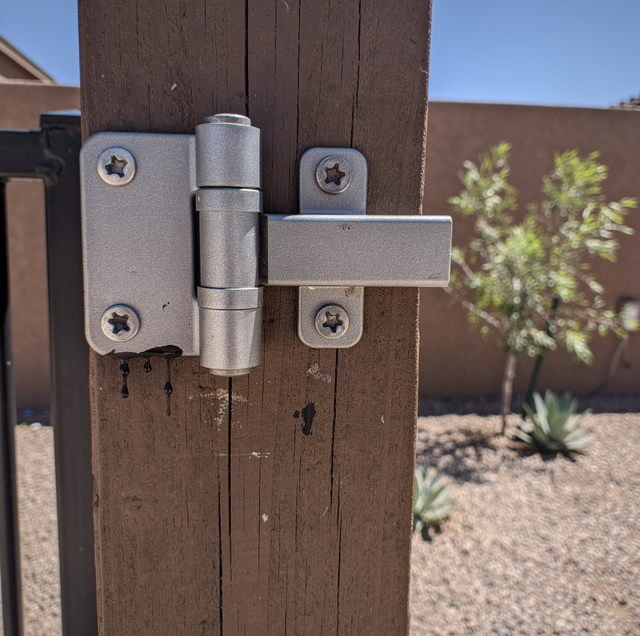
Six months ago this gate swung shut with a soft click every time you let go of it. Now it takes a shove partway through the arc just to get the latch to line up, and a scrape mark on the paver below traces exactly how far it drags before it clears. The panel hasn't warped, and the post hasn't shifted; what's changed is spinning quietly at two points against the post, wearing down a little more with every open and close.
How Hinges Actually Carry a Gate's Weight
A swing gate's entire weight rides on two or three hinge points welded or bolted to the post. Each hinge is really a pin rotating inside a bushing or collar, and that pin-to-bushing contact is exactly what wears down with every open-close cycle. Weld-on hinges, welded directly to both the post and the gate frame, generally hold up better under heavy daily use than bolt-on hinges, which depend on the bolts staying tight in their holes over years of vibration and movement.
The Early Warning Signs
Gradual sag at the latch side: The gap at the bottom widens slowly over months as the pin and bushing wear, and the corner of the gate farthest from the hinge post drops closer to the ground.
Metal-on-metal grinding or squealing: A sound that grease alone won't permanently fix if the noise comes from a worn pin and bushing rather than from simple dry contact.
Visible play when the gate is lifted at the latch side: Grab the gate near the latch and lift. More than a small amount of vertical movement at the hinge means the pin has worn loose inside its bushing.
The gate swings shut on its own, or won't stay open the way it used to: Hinges are often set with a slight intentional lean so gravity helps close the gate; worn hinges shift that geometry enough to change how the gate behaves.
Cracking or rust starting right at the hinge weld: The constant flexing at that joint is exactly where a weld under repeated stress cracks first, and rust there is a sign that the coating has already failed at a high-stress point.
An uneven gap along the latch edge, wider at the top than the bottom, or the reverse. This shows the gate has twisted slightly on its hinges rather than sitting square, unlike a post problem, where the whole frame leans as one unit.
What Causes Hinges to Wear Out Early
A gate heavier than its hinges were rated for accelerates pin and bushing wear well ahead of schedule. Skipping periodic lubrication lets grit work into the pin-bushing gap and act like grinding paste rather than protection. Sun exposure bakes standard grease dry faster on an install with no shade, leaving metal-on-metal contact for weeks between service visits. And a gate that swings wide open and slams into a stop repeatedly puts shock loading through the hinge that steady, controlled use never does.
Repair or Replace the Hinge Hardware
A hinge with a worn bushing but a sound pin can sometimes be fixed by replacing just the bushing. Once the pin itself shows a visible groove or step worn into it, replacing the pin alone often isn't enough, since it has already lost its true round shape, and replacing the whole hinge assembly becomes the more lasting fix. On a gate that's been undersized for its hinges from the start, upgrading to a larger-diameter pin and a heavier weld-on hinge plate addresses the root cause rather than repeating the same wear cycle with new parts.
How Often Hinges Should Actually Be Checked
A gate that cycles several times a day, a main driveway gate used by every vehicle on the property, wears through lubrication faster than a side gate opened once a week. As a general habit, a quick lift-and-check at the latch side every few months catches play well before it turns into a visible sag, and a fresh application of grease at the same interval keeps grit from working its way into the pin-bushing gap in the first place. Waiting until the gate is already dragging means the wear has had months to compound, and by that point a simple regrease rarely solves what's become a bushing or pin problem instead.
Why Two Identical Gates Can Wear at Different Rates
Two gates built to the same weight and hung on the same hinge hardware won't necessarily wear out on the same schedule. Daily cycle count matters more than most owners expect: a gate opened forty times a day by a family with several vehicles puts roughly ten times as many wear cycles through its hinges as one opened four times a day, and that difference shows up in years, not months. Sun exposure plays a role too, since a hinge baking in direct light all afternoon dries out standard grease faster than one shaded by a wall or landscaping most of the day, leaving it running dry for longer stretches between service visits even on an identical maintenance schedule.
| Sign | What's Actually Happening | Typical Fix |
|---|---|---|
| Gradual sag at the latch | Pin and bushing wear | Lubricate or replace the bushing |
| Grinding sound | Dry or worn pin contact | Clean, regrease, inspect the pin for grooving |
| Visible lift or play at the hinge | Pin worn loose in the bushing | Replace pin and bushing as a set |
| Gate won't stay open like before | Hinge lean or geometry has shifted | Reset or replace hinge; check post plumb too |
| Cracking at the hinge weld | Repeated flex fatigue at a stress point | Re-weld and reinforce, consider a heavier hinge plate |
What a Hinge Inspection Actually Checks
A real hinge inspection covers more than a glance and a squirt of grease. It includes lifting the gate at the latch side to measure actual play at each hinge, checking the pin itself for visible grooving where it's worn against the bushing rather than assuming the bushing alone is at fault, and inspecting the weld or bolt connection at both the post and the gate frame for any hairline cracking that a quick look from a few feet away would miss. Checking all three hinges on a heavier gate matters too, since wear is rarely even across them, and a hinge that looks fine from the driveway can be the one closest to failing once you're actually up close with a light and a pry bar.
Frequently Asked Questions
A small amount of play, roughly the thickness of a coin when the gate is lifted at the latch, is normal clearance built into most hinge designs. Anywhere near a quarter inch or more of vertical movement generally means the bushing has worn through and metal is contacting metal directly.
Grease resolves the noise if the pin and bushing are still round and undamaged. If the squeal returns within a few weeks of regreasing, that's usually a sign the bushing has worn oval rather than round, and no amount of grease corrects a shape that's already off.
Beyond a certain gate weight, fabricators often switch from a simple pin-in-sleeve hinge to a ball-bearing hinge, which supports the load on a bearing race instead of direct pin-to-bushing contact. That change cuts wear dramatically on gates that cycle many times a day.
The bottom hinge typically carries more of the gate's static weight, while the top hinge does more of the work resisting the twisting force when the gate is pushed or caught by wind. Wear often shows up first at different hinges depending on which force dominates for that particular gate.
Not exactly. A gravity hinge uses a slight cam or lean built into the hinge itself so the gate's own weight pulls it shut, while a spring-loaded hinge adds a mechanical spring for the closing force. The two wear differently, since the spring type has an extra moving part that fatigues on its own over years.
Yes. A gate riding on badly worn hinges puts uneven, shifting stress on both the hinge weld and the post it's anchored to, which can crack a weld or loosen a post's footing well before the hinges themselves are addressed, turning a hardware fix into a bigger repair.
When did you last lift your gate at the latch side and check for play? If the honest answer is "I don't remember," that's this week's five-minute job. Do it now, and in the worst case, you spend a few dollars on grease. Wait for the grinding to turn into a visible sag and the job turns into a hinge plate replacement, sometimes with a post repair added on once the shifted weight has had a season to work on the footing too.
Schedule a hinge and hardware inspection — catch hinge wear before it turns into a bigger repair. Sunset Gates serves Tempe and the East Valley. Call (480) 210-1572.
