
Solar vs. Hardwired Gate Operators: Which Lasts Longer?
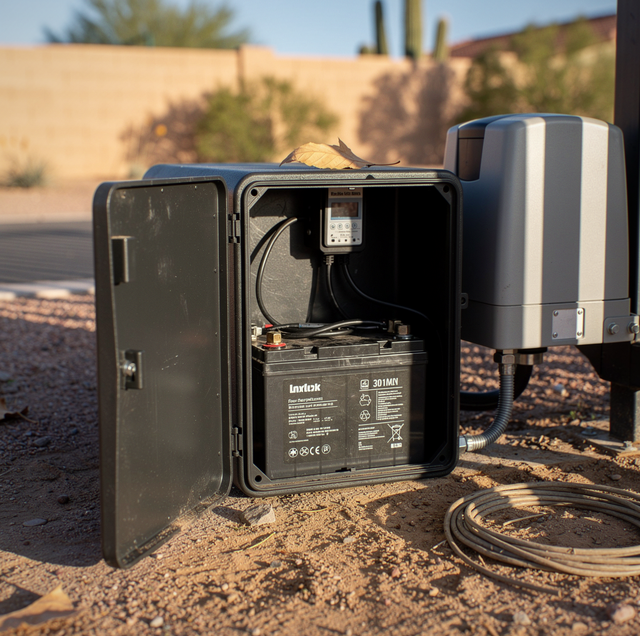
The run from the electrical panel to the gate posts measured almost 200 feet, all of it through decorative rock and a paver walkway that would need to be cut open and patched to bury conduit. That single number was what actually decided solar over hardwired, not a preference for either system.
How a Hardwired Operator Actually Powers the Gate
A hardwired system runs low-voltage wire underground in conduit from a control box's power-step-down unit back to the gate operator, which draws continuous power from the house circuit. Because the electronics stay connected to that circuit around the clock, a hardwired system is more exposed to voltage spikes traveling through the wiring than a system that's electrically isolated.
How a Solar Operator Actually Powers the Gate
A solar setup uses a photovoltaic panel to charge a deep-cycle battery through a charge controller. The operator draws only from that battery, never directly from the panel, which is why it keeps working through cloudy stretches and after dark as long as the battery holds enough charge. Sizing the panel correctly means accounting for how many times a day the gate actually cycles, since more daily opens and closes draw the battery down faster than the panel alone can replace on a short winter day.
Where Each Type Has the Real Advantage
Hardwired systems offer effectively unlimited power, support faster sustained operator speeds, and never need a battery replaced. They make the most sense when the run from the power source is already short and won't require much trenching through finished landscaping.
Solar systems avoid trenching, and conduit runs across long distances entirely, keep working through a grid power outage since they're never tied to house current, and are easier to relocate later since there's no buried wire to abandon if the layout changes.
Heat, Sun Exposure, and How Long Components Actually Last
Batteries lose usable capacity faster under sustained high heat. A deep-cycle battery that might run for five or more years in a mild location can drop to closer to three years when mounted against a stucco wall or pillar that radiates heat back onto it through the afternoon. Panel placement and angle affect how much charge actually gets collected: a panel mounted flat against a south-facing wall gathers less over a full year than one angled and kept clear of shade cast by landscaping or a pillar.
Hardwired control boards and their power-conversion components face a different heat-related risk. Because they stay connected to house power continuously, they're more exposed to surge damage during storm-related grid fluctuations. A surge protector rated for the circuit is worth adding regardless of which system you choose, since both types of electronics sit outdoors year-round.
Battery and Panel Maintenance a Solar System Needs
Deep-cycle batteries typically need replacing every 3 to 5 years depending on heat exposure and daily cycle count. Panels benefit from periodic wiping down, since dust buildup measurably cuts the amount of charge they collect. Charge controllers are worth checking occasionally too, confirming the battery isn't being chronically overcharged or undercharged, either of which shortens its usable life well before the stated replacement interval.
What Installation Actually Looks Like for Each Type
A hardwired install means trenching a channel from the power source to the gate posts, running conduit through that trench, pulling low-voltage wire, and patching whatever landscaping, pavers, or hardscape sat along that path. The length of that run drives most of the labor; a short run along an existing planting bed is a different job than one crossing a finished driveway or a paver walkway that has to be cut and relaid. A solar install skips the trenching entirely: the panel mounts on a post, pillar, or nearby wall angled toward the open sky, the battery and charge controller sit in a weatherproof enclosure near the operator, and the whole system is self-contained from day one. That difference in disruption to existing landscaping is often the deciding factor even before either system's long-term performance enters the conversation.
Signs a Solar System Is Undersized for the Property
A solar setup that seemed to work fine when it was new can start showing strain as it ages or as gate use increases. The clearest sign is a gate that operates normally in the morning but moves noticeably slower, or stalls partway, by late afternoon after a full day of cycles have drawn the battery down faster than the panel replaced that charge. Cloudy stretches lasting several days in a row can expose the same weakness in a system that was only ever sized for average daily sun. When that pattern shows up repeatedly rather than during one unusual week, it usually means either the panel is undersized for the gate's actual daily cycle count, or the battery has aged past the point where it holds a full charge.
| Factor | Solar | Hardwired |
|---|---|---|
| Power source | Panel and deep-cycle battery | Direct connection to house circuit |
| Install disruption | No trenching or conduit run needed | Conduit trenched from panel to gate |
| Backup during outage | Continues working on battery | Requires manual release unless battery-backed |
| Heavy daily use | Limited by panel size and battery capacity | Effectively unlimited |
| Main wear component | Battery, replaced periodically | Surge exposure to control board |
Which Operator Types Pair With Each Power Source
Not every gate operator design works equally well with both power sources. Slide gate operators and heavier swing operators built for larger, more frequent-use gates often draw more current per cycle than a small residential solar setup can comfortably replace between uses, which is part of why heavier commercial-style operators lean hardwired more often. Lighter-duty swing operators built specifically for solar use typically run on a lower-current motor and a control board tuned to conserve battery charge between cycles, trading some top speed for lower draw. Matching the operator's actual current draw to the power source, rather than picking a power source first and assuming any operator will work with it, avoids a mismatch that later shows up as sluggish operation or a battery that never quite catches up.
Frequently Asked Questions
As a general estimate rather than a fixed spec, most residential solar operators are sized for somewhere around 10 to 20 cycles a day on an average panel and battery combination, though exact capacity varies by manufacturer and panel size. A property with heavy daily traffic, such as delivery trucks or multiple vehicles, can outpace what the panel recharges, which is the main reason some solar installs add a second panel instead of assuming one will keep up.
Yes, and it's a common mid-life change. The operator itself typically doesn't need replacing, only the power source, so an electrician runs conduit and adds a power-step-down unit while the existing panel and battery can stay in place as an outage backup.
Not on its own. Without a battery backup added at the control box, a hardwired gate drops into manual-release mode during an outage. Typically, a key-operated lever or knob at the operator disengages the motor, allowing the gate to be pushed open by hand, though it won't cycle automatically again until grid power returns. Solar isn't entirely immune to outages either: it keeps working through a grid outage because it was never drawing from the grid in the first place, but an extended cloudy stretch during that same outage can still drain the battery faster than the panel replaces it.
It's usually not a direct strike but an induced voltage surge traveling back through the buried low-voltage wire from a nearby lightning event or a grid fluctuation. That's why a dedicated surge suppressor at the control board matters more than most owners expect.
Direction matters less than most owners assume once the panel is angled and unshaded. A fixed panel that's off true south by 20 or 30 degrees typically loses only a modest share of its annual output, nowhere near the difference direction alone implies. Shading matters more in practice: a panel that catches even two or three hours of shadow from a nearby wall, tree, or roofline during peak sun loses more charge over a year than a poorly aimed but fully unshaded panel does.
A quality deep-cycle battery in a moderate location can last five or more years, but sustained heat exposure against a dark, sun-facing wall often shortens that to about three years, since heat accelerates the internal chemical breakdown that limits a battery's usable life. Sealed AGM batteries tend to tolerate heat cycling better than a flooded lead-acid battery of the same capacity, which is part of why most gate-operator manufacturers now spec AGM as standard, even though it costs more upfront.
A short, easy run to reliable grid power makes hardwired the practical default almost every time. A long run through finished landscaping, or a property where outages are a real concern, makes solar worth the extra planning. If the distance is borderline, get quotes for both before ruling either one out — the price gap is often smaller than owners expect once trenching and patching costs are actually on the table.
Get a free on-site gate automation estimate — find out which power source fits your property's layout and daily use. Sunset Gates serves Tempe and the East Valley. Call (480) 210-1572.
