
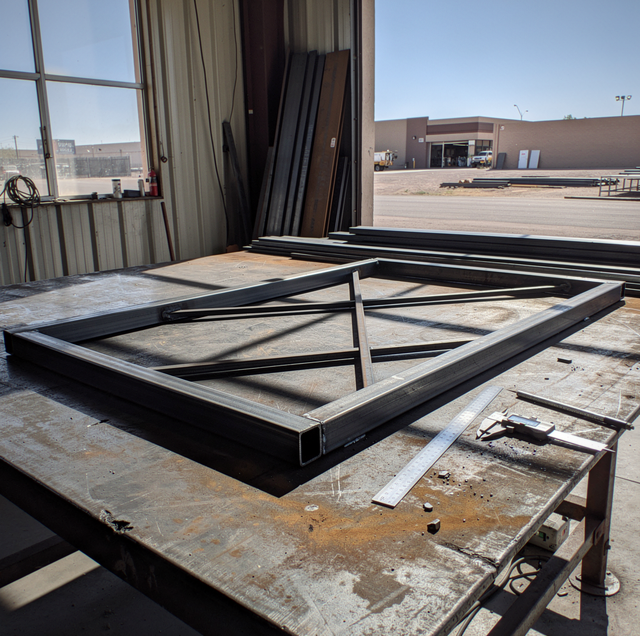
Quick Answer: Ask what makes a gate heavy-duty and the first answer points at the steel: more of it, thicker, heavier. Thicker steel is one piece of the answer. A gate earns the label when its frame, posts, hinges, and finish are all sized together for the load that a single opening will carry, not when a single part gets beefed up while the rest stays standard. A wide leaf on a light frame, or a heavy frame on undersized hinges, still fails at the weakest point.
Frame Tubing, Wall Thickness and Bracing
A gate frame is built from rectangular or square steel tubing, and two numbers set its strength: the outside dimension of the tube and the thickness of its wall. A narrow, single-leaf gate opened by hand can get by on a modest perimeter tube with a thin wall. Step up to a wide leaf, a double-swing opening, or a gate that cycles with every car in and out, and both numbers need to grow because a thicker-walled tube resists twisting better than a thin-walled tube.
Bracing is the other half of a strong frame. A rectangle of tubing with pickets filling the middle flexes at the corners under repeated swinging, and that flex eventually shows up as a sag at the latch, even when the hinges and post underneath are sound. A diagonal brace running corner to corner, or a full cross-brace on a wide double leaf, ties the frame into a rigid triangle instead of a loose rectangle that racks under repeated swinging. A narrow gate can go without a full brace. A wide one needs it to keep the frame square.
The joints are part of the spec as well. On a heavy-duty frame, each corner and each brace end is welded all the way around the tube, whereas a lighter build can carry welds only on the visible faces. A weld that stops short of wrapping the tube leaves the unwelded side of that joint free to flex, and a crack can start at that side under a heavy leaf.
Posts and Footings
None of that frame strength matters if what it's bolted to can't hold still. A heavier, wider leaf requires a post with greater wall thickness and a footing set deeper and wider than a light single gate does, because the post acts as a lever arm every time the leaf swings. Undersizing the post to save on the footing, even a strong frame can still end up leaning.
Hinges and Bearings That Carry the Weight
A heavy-duty hinge is defined by how it is built from day one. A standard pin-and-bushing hinge, welded or bolted through a small mounting tab, works fine for a gate whose weight and cycle count stay modest. A heavy leaf asks more of that same joint: a larger-diameter pin, a bearing race instead of a simple bushing to spread the load as the gate swings, and a mounting plate welded across a wider footprint on both the post and the frame instead of a single small tab trying to carry the whole moment of a heavy, wide leaf.
That mounting plate matters as much as the pin. A hinge rated for a heavy load, but bolted through the same thin tab used on a light gate, just moves the weak point from the pin to the weld. Heavy-duty hinge hardware and heavy-duty mounting go together; picking one without the other leaves a gap the gate eventually finds.
A sagging heavy gate can suddenly swing or drop under its own weight. Keep hands and fingers clear of the hinge side and any operator arm, and never attempt DIY welding on a loaded frame; have a fabricator handle structural repairs.
The Finish
Thickness and sun exposure both affect what "heavy-duty" means for a finish. Direct, unshaded sun and its UV break down a thin coating over time, and once that thin layer chalks or cracks, the steel underneath is exposed. On a gate that sits under milder sun or in shade, the same thin coating's breakdown stays slight. That split is why finish build belongs on the heavy-duty spec for a gate in full sun, right alongside the steel, while a shaded gate can carry a standard finish without leaving the frame exposed. A gate spec'd heavy in the frame but left with a thin finish in full sun is still only as protected as its weakest coat.
Finish build is also a number that can be checked. Coating thickness is measured in mils, thousandths of an inch, with a dry-film thickness gauge, so a heavy-duty finish can be written into the spec as a film build and confirmed on the finished gate rather than judged by eye.
When a Gate Needs to Be Heavy-Duty
Width, automation, wind exposure, and heavy traffic each push a gate out of standard territory and into heavy-duty territory. Width comes first: every extra foot of leaf adds strain that the hinges and post have to resist on every open and close, so a wide single leaf or a long double-swing gate needs the upgrade even if it never sees a car. Automation adds its own load, since a motor cycling the gate at every arrival and departure puts steady, repeated stress on the same hinges and frame that a hand-operated gate in a quiet side yard never sees. Wind exposure matters too, especially on a solid-panel design that takes the full force of the wind, where an open picket pattern lets it pass through. Daily vehicle traffic and commercial or shared-entry use both raise the cycle count the same way automation does, just with more mass moving through the opening each time.
Each reason a gate moves up a class changes a specific part of the build:
| Situation | What Needs to Step Up |
|---|---|
| Wide single leaf or long double-swing gate | Frame tube size and diagonal bracing |
| Gate runs on an automatic operator | Hinge bearing type and a mounting plate sized to match |
| Exposed to strong, sustained wind | Panel design (open pickets over a solid face) and post sizing |
| Daily vehicle or commercial/shared-entry use | Hinge and hardware rated for a higher cycle count |
| Full, unshaded sun exposure | Finish thickness and coating build |
A gate that meets two of these situations takes both upgrades from the table: a wide leaf on an automatic operator gets the larger frame tube and bracing for its width, plus the bearing hinges and reinforced operator plate for its motor.
Frequently Asked Questions
Yes. A heavy leaf swinging shut carries enough momentum that it needs a positive stop, a stop post or a ground stop the leaf closes against, so the latch holds the gate in place without also having to halt it. A latch used as the stop takes that full swing load on every close and can bend out of line with its keeper.
A third hinge shares the load only if all three pins sit on one straight axis. A hinge welded even slightly off that line binds the leaf as it swings and forces load back onto the other two, so a third hinge on a heavy leaf is set with the pins aligned across all three before any of them is welded.
It does. A solid panel presents a continuous face to the wind and has to shed that entire load through the hinges and post, whereas an open picket pattern lets wind pass through the gaps rather than loading the entire leaf. For a wide gate in an exposed spot, the open design is the lower-load choice, regardless of how thick the frame tubing is.
Both. An automatic operator adds a mounting point and a pushing or pulling force to the frame at the spot where the arm attaches, on top of the repeated cycling that already stresses the hinges. A frame that was fine for occasional hand use can flex or crack at the attachment point once it cycles under motor power, which is why an automated gate gets a reinforced plate at the operator arm attachment.
In part. A diagonal brace can be welded into an existing frame, and light hinges can be cut off and replaced with bearing hinges on wider plates, provided the frame tube is thick enough to support the new welds. A frame tube too thin for its span cannot be thickened, so that leaf is rebuilt rather than reinforced.
On a swing gate, yes. The hinge post carries the leaf's full weight on every swing, while the latch post only supports the closing leaf and the latch, so a heavy-duty build places the heavier tube on the hinge side. A matched pair of posts sized for the latch side leaves the hinge post undersized.
Commission a heavy-duty driveway gate built to your opening — frame tubing, hinges, posts and finish sized together to the width, traffic and sun the gate will see. Sunset Gates serves Tempe and the East Valley. Call (480) 210-1572.
