
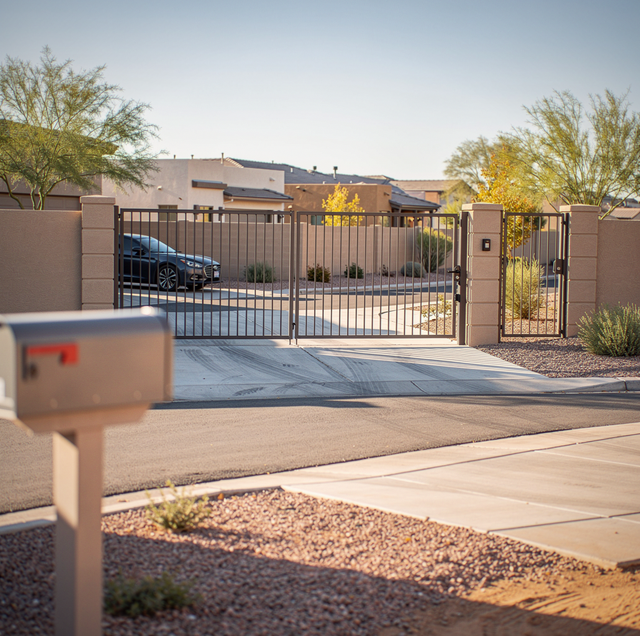
A driveway gate answers to one household. A community entry gate serves every resident, every guest, every delivery driver, and every service vehicle that enters the neighborhood in a day, all through the same opening. That difference changes the whole decision. A single-family buyer can pick a gate on style first; a board sitting down to choose a community entry gate works through traffic, waiting cars, who gets let in and how, and who arranges the upkeep, and style enters the conversation only after those questions are settled.
Each of those decisions changes something about the gate itself:
| Decision | What the Board Weighs | How It Shapes the Gate |
|---|---|---|
| Traffic through the entry across a day | How arrivals and departures cluster at certain times versus a quiet stretch between them | Sets how heavy-duty the frame, hinges, and operator need to be |
| Separate entry and exit lanes | Whether one gate can serve both directions or the site needs its own lane each way | Decides between a single shared vehicle gate and two independent ones |
| Room for cars waiting to enter | Whether a car waiting on the gate can sit clear of the public street | Sets the setback between the street line and the gate |
| Resident and visitor access method | How a resident gets in versus how a guest, contractor or delivery driver gets in | Decides which access devices tie into the gate's control board |
| Emergency and service vehicle access | How fire, medical, trash and utility crews reach the community without waiting on a code or a call | Sets what override the gate needs for those vehicles |
| A pedestrian gate | Whether residents on foot, with strollers or on bikes share the vehicle opening | Decides whether a separate walk-through gate and path get built alongside it |
| The look against the community's architecture | Whether the gate looks built for the entrance or bolted onto it afterward | Sets the gate's style, panel design and finish |
| Upkeep and who arranges it | Whether the HOA, a management company or a maintenance contract handles repairs and inspections | Decides who the gate's fabricator and installer answer to after the install |
Traffic Through the Entry and What It Asks of the Gate and Operator
A single household's driveway gate opens when that household comes or goes, spread through the day with real rest between cycles. A community entry gate carries every household in the neighborhood through one opening, and the traffic clusters at certain times: a run of cars leaving together in the morning, another run arriving together in the evening, then a long quiet stretch until the next cluster. The gate and its operator have to open, close, and be ready again inside that cluster, and that repeated, close-together cycling is the load a community gate is built for. Its frame, hinges and operator are heavy-duty from the start, sized to carry clustered traffic.
Entry and Exit Lanes and Room for Waiting Cars off the Street
Before the board picks a style, it has to settle whether one gate serves both directions or the community needs a separate lane for entry and a separate lane for exit. A single shared lane means that an arriving car and a departing car cannot use the gate at the same time, so whichever is not moving waits its turn. Two independent lanes let entry and exit happen at once, but that means two gates, two operators, and more room at the entrance to build them side by side. Either way, cars waiting to get through the gate need somewhere to sit that is not the public street. A gate set back from the road, with a paved apron in front of it, keeps a line of arriving cars off the roadway while they wait their turn; a gate hung close to the street line pushes that same wait onto through traffic.
Resident and Visitor Access at a Shared Gate
A shared entry has to let in residents, the guests they expect, and drivers or crews there for a single visit, and the board chooses the gate's access devices around those three groups.
An automated gate can strike or trap a person. No one rides, climbs, or crosses it in motion or adjusts its operator or sensors. One that stalls, reverses late, or closes on an obstruction is shut down until a technician repairs it.
Emergency and Service Vehicle Access
A locked or coded gate has to let a fire engine, an ambulance, or a trash truck through without a wait, so emergency and service access gets settled before the gate goes in. How the local fire authority gets through, whether by a dedicated override, a shared code, or a system it can trigger from its own vehicle, is arranged directly with that authority and confirmed through the board's own approval process. Routine service vehicles, from utility trucks to landscaping and maintenance crews, get their own entry arrangement settled at the same stage.
A Pedestrian Gate beside the Vehicle Gates
Not every resident who reaches the entrance is in a car. Someone walking a dog, a jogger heading out for a loop, a parent with a stroller, or a resident on a bike all reach the same entrance the cars do, and routing every one of them through the vehicle opening puts a person on foot in the same space as a moving gate and a line of cars. A pedestrian gate built into the entry, set beside the vehicle gates with its own narrow opening, gives foot traffic a path set clear of the vehicle gate's swing or slide path. It carries its own access method too, since a device sized for a car's dashboard or a driver's window is not always the right fit for someone on foot or on a bike, and a board planning the vehicle gate should plan the pedestrian gate in the same decision.
Matching the Community's Architecture and Finish
A community entry gate sits at the one spot every resident and every visitor sees first. A board choosing panel style, height, and how open or solid the design reads is choosing how the entry represents the whole community, and a design that matches the entry wall, the gatehouse, or the clubhouse's materials reads as one coordinated entrance. Over time, the finish carries that look: a powder-coated finish holds its color and resists chipping better than site-applied paint.
Upkeep Planning for a Gate the Whole Community Uses
A driveway gate is one household's job to notice when something is off and one household's decision to call for service. A community gate serves everyone and belongs to no one in particular, so the board assigns upkeep, deciding upfront whether the HOA handles service calls directly, whether a management company fields them, or whether a maintenance contract covers routine inspection and repair on a set schedule, and residents need to know who to contact when the gate is stuck open, stuck closed, or acting up. That assignment is worth settling at the same meeting where the board picks the gate itself.
Frequently Asked Questions
Yes. Operators are rated by duty class, from light residential up through commercial and industrial, and a shared community entry, with its clustered arrival and departure traffic, calls for an operator rated for commercial duty rather than a residential one, even on a gate that looks about the same size as a large driveway gate. The class rating indicates to an installer whether a given operator can withstand a shared entry's cycling pattern.
Sightlines count alongside pavement width. A single shared lane can work when a driver arriving and a driver leaving can see each other in time to yield, but a curve in the approach, a wall, or landscaping near the entrance can block that view even when the lane itself has plenty of room. A board weighing one lane against two should walk the approach itself and check what a driver can and cannot see before assuming width alone settles the question.
A driver who is refused at the gate, or who pulls up to the wrong entrance, needs a way to leave forward without backing into the street. A turnaround in front of the gate, or a lane that loops a refused car across to the exit side, gives that driver a way out, and it gets drawn into the entrance layout along with the space where arriving cars wait.
Where the local fire authority asks to see it work, the check runs with one of its own trucks, since a fire engine or ladder truck sweeps a wider path through the opening than a car, and a fully open gate that clears a sedan can still catch a truck's mirror or overhang. The board and the fire authority set that check as part of bringing the gate online.
Not always. On a tight site with no room for a separate walk gate and path, a narrow pedestrian door can be set into the entry wall or a pillar beside the vehicle opening, taking up less ground than a free-standing gate. It ties into the same access system as the vehicle gate, so a resident's credential can work at both, with hardware sized for a person on foot.
The installer's contact is whichever party signs the service agreement, and where that is the management company, who decides on a repair is set by the HOA's governing documents and its management contract. A board that keeps its own copy of the installation and service records holds on to the gate's service history when a management contract changes hands.
Engage custom fabrication for your HOA's community entry gate — the vehicle gates, their operators, and a pedestrian gate, built to match the community's architecture. Sunset Gates serves Tempe and the East Valley. Call (480) 210-1572.