
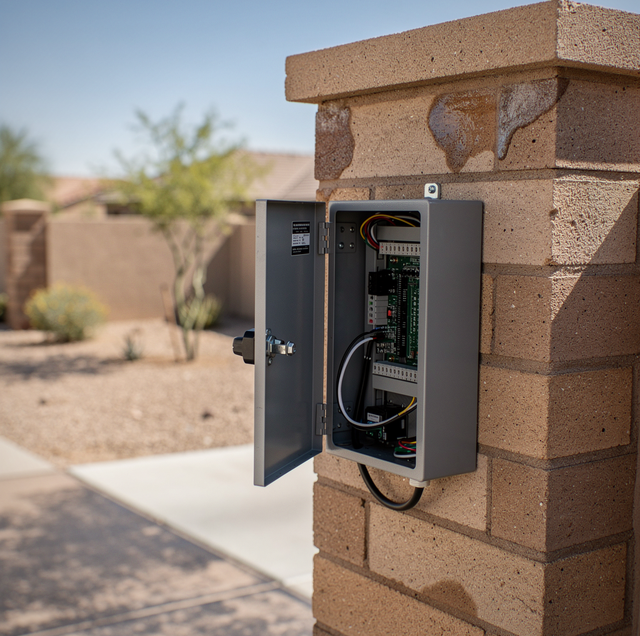
The storm rolled through an hour ago, the power is back on in the house, and the driveway gate still will not move. No hum, no lights on the keypad, nothing when you press the remote. A surge riding in on the utility line or the buried low-voltage wiring can take a gate opener down all at once, rather than the gradual failure of a worn hinge or a tired battery. Here is the order to work through, from getting your car out safely to deciding whether the operator gets fixed or replaced.
Step 1: Make The Gate Safe And Open It By Hand
Before anything else, get the gate open without fighting the motor. A gate that lost power mid-cycle can sit at an odd angle or partway across its opening, so treat it as unpowered rather than assume it is simply "off." Every operator comes equipped with a manual release built for exactly this moment, but the release itself varies by design: some use a key to turn a lever, some use a knob, and some require a specific sequence to disengage the arm or drive gear from the gate. Follow the maker's instructions for your specific unit rather than guessing, since forcing the wrong lever can bend it.
A gate whose power comes back while its release is only half set can restart and swing or slide without warning. Switch the gate breaker off before using the release, keep people and cars clear, and leave the housing to a technician.
With the release engaged, push the gate through by hand. A swing gate should move on its hinges with no more resistance than its own weight; a slide gate should roll along its track. If it drags, binds, or will not budge even with the operator disengaged, something beyond the electronics may be wrong, and that is a separate problem from the surge itself.
Step 2: Check What You Can Safely Check
A handful of checks belong to the homeowner and take only a few minutes.
The breaker: If the breaker feeding the gate had already tripped when you went to switch it off, note it. A tripped breaker cuts power to the gate but does not shield it from a voltage spike. Once the release is set back for your unit and people and cars are clear, turn the breaker on once; if it holds and the gate still does nothing, the fault is past the breaker.
The outlet or the solar indicator: If the operator plugs into or draws power through a nearby outlet, check whether that outlet has a reset button and press it if the button has popped. On a solar-powered gate, look at the charge controller or the small indicator light near the battery enclosure; a light that is dark or blinking in an unfamiliar pattern points toward the battery, the charge controller, or the charge path.
The keypad and remote: Look for a backlight or status light on the keypad. If it is lit but the gate still does not respond, the fault lies beyond the keypad's light: its output, the wiring, the control board, or the operator. If the keypad itself is dark along with everything else, that is consistent with a surge that affected the entire low-voltage circuit rather than a single component.
None of this tells you exactly what failed inside the operator housing, and that is fine. The point of this pass is narrowing the problem to "get a technician out" versus "this was just a tripped breaker," not diagnosing the board yourself.
Step 3: What A Technician Tests Before Touching Anything Else
Once the call is made, the diagnostic order inside the operator housing runs from the smallest, most easily swapped part to the most involved.
Fuses: A control board carries one or more small fuses that open when a surge drives excess current through it. A blown fuse with no other damage is the best-case outcome after a surge, and it is checked first for exactly that reason.
The surge suppressor: If the control box has a suppressor installed, it is also a sacrificial part by design. These are built to absorb a spike and then fail in a way that shows visible damage or reads as an open circuit, which tells a technician it needs replacing, and the board behind it still gets tested.
The control board: If the fuses and suppressor are intact but the board still shows no response, test the board for continuity and output at its terminals. A board that took a direct hit can show scorched traces or a burnt smell, but surge damage is often invisible to the eye and only shows up under a meter.
The motor: Last, the motor windings are checked, since a surge that gets past the board can still reach the motor in some designs. A motor that hums but will not turn, or that trips a breaker every time it is asked to run, points to winding damage, a failed start capacitor, or a mechanical bind, which the technician can separate with the gate released.
Step 4: Repair Or Replace A Surged Control Board
A blown fuse or a sacrificed surge suppressor is a plain swap. A damaged control board is a different decision, and it comes down to a few practical questions: how old the operator is, whether a matching board is still available, and how the board replacement compares with replacing the operator as a unit. An older operator whose board is hard to source is sometimes replaced as a unit rather than repaired piecemeal, while a newer system with an available board is a simple repair.
Repeated surge damage on the same gate is also worth factoring into that decision. Heat is hard on gate electronics on its own, and a property that also sees frequent power surges puts extra strain on the same control board and battery, which is part of why some owners weighing that combination choose to go without powered automation at all. A property where surges and heat extremes are uncommon carries little of that added risk, which keeps a board repair the plain answer.
Step 5: Protecting The Operator After It's Back Up
Once the gate is running again, adding a surge suppressor at the control box is worth it if the system does not already have one, since it gives the next spike something to absorb before it reaches the board. An existing suppressor that has already taken a hit should be replaced rather than left in place, because a suppressor that has absorbed a surge may not have much protection left to offer the next one.
Ask the technician to log which parts were replaced and the date, then keep that note with the gate's paperwork. If the operator surges again, the record shows the next technician which part keeps failing.
It is also a reasonable time to confirm the operator's backup battery, if it has one, held its charge through the outage and the repair. A battery that was already marginal before the surge can look fine on a quick check and still fail the next time grid power drops, so ask the technician to test it.
Frequently Asked Questions
Rarely the gate itself. The gate panel, hinges, track, and posts are mechanical and carry no electronics, so a surge traveling through the wiring has nothing to damage there. The exception is any sensor or accessory mounted on the gate itself, such as a photo-eye bracket with its own low-voltage wiring, since that wiring can carry the same spike back to whatever it is connected to.
They protect different things. A whole-house unit at the electrical panel reduces the size of a spike entering the home's wiring, while a dedicated suppressor at the gate's control box protects that specific low-voltage circuit, which runs underground or along a fence line, where the wiring feeding an indoor outlet never goes. Having one does not make the other unnecessary, since a large spike can still leave enough residual voltage on a long buried run to affect a control board even after a whole-house unit has clipped the worst of it.
Yes. A replacement board has no memory of the old one's settings, so it needs to relearn each remote, any keypad codes, and the gate's open and close travel limits before it will run on its own again. Bring your remotes to the appointment, or have their codes written down, so the technician can pair them while the new board is already open.
A battery backup protects against a loss of power, not against a spike traveling through the wiring while power is still present. The surge can pass straight through the charging circuit or the control board on its way to or from the battery, so having backup power does not shield the electronics from voltage damage the way it shields against an outage.
Resetting a tripped breaker once is reasonable, since it restores power without harming anything. If it trips again immediately when you try the gate, stop and leave it off, since a repeat trip points to a short or a seized motor downstream, which resetting again will not fix and could make worse.
It depends entirely on which part failed. A blown fuse or a sacrificed suppressor can be a same-visit fix when the technician carries the matching part. A control board that needs a special-order part, or an operator old enough that a matching board is no longer stocked, can take longer simply waiting on parts rather than because the repair itself is complicated.
Get the surge damage found and fixed — repair or protect your gate opener before the next storm strands you. Sunset Gates serves Tempe and the East Valley. Call (480) 210-1572.