
Why Gate Posts Fail and How Proper Setting Stops It
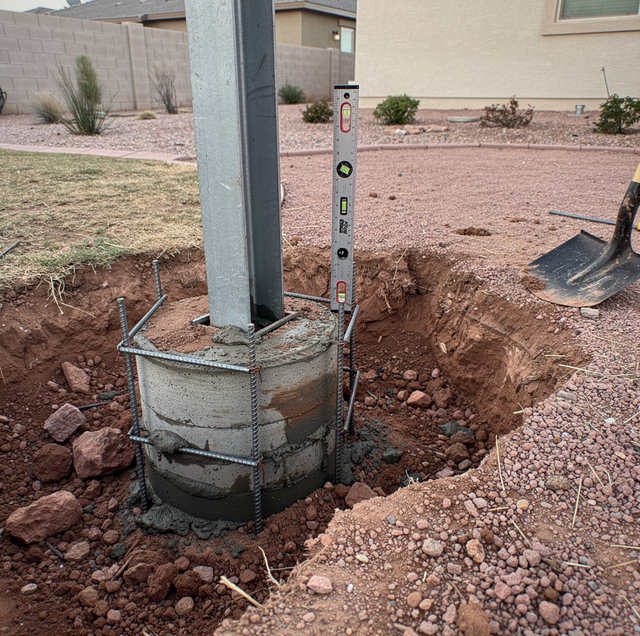
The gate itself still swings fine off the hinges. Tested on a pair of sawhorses, it hangs dead level and closes without a fight. Bolted back onto the post, though, the whole thing leans two inches out of plumb, and the latch no longer lines up with the receiver. The post moved. The gate never did.
The Post Is the Foundation, the Gate Is Just the Load
A gate post works like a small cantilevered column: one end is fixed underground, and it carries far more than the gate's static weight. Every time the gate swings and stops, that motion applies a rotational, twisting force at the base of the post, multiplied by the length of the gate acting as a lever arm. A 200-pound gate swinging on an 8-foot arm puts meaningfully more stress on the buried section of the post than 200 pounds sitting still ever would.
Why Posts Lean, Heave, or Crack
Several factors drive that failure, usually in combination rather than in isolation.
Shallow bury depth: a post set only 18 to 24 inches deep is often too shallow for the load it's carrying. As a rule of thumb, roughly a third of the post's total length should sit below grade, which works out to about half the post's above-ground height buried in addition to what shows. A post standing 6 feet above ground generally wants at least 36 inches buried to hit that target, more for a heavy double gate.
Undersized footing: a footing poured just wide enough to wrap the post gives the concrete almost no resistance to twisting. A footing that flares wider at the bottom than at the surface, sometimes called a bell shape, resists both uplift and rotation far better than a straight-sided cylinder of the same depth.
Soil movement: alkaline, clay-heavy soil that expands when wet and contracts when dry can slowly rock a footing that isn't set below the zone where that seasonal swelling happens, especially near irrigation lines.
No rebar or anchor: a plain concrete plug with nothing tying it to the post can crack and separate from the steel under repeated cycling. A rebar cage or a cross-pin welded into the buried section keeps the concrete and the post moving as one unit, rather than the post slowly twisting inside a cracked collar.
Water pooling at the base: irrigation or drainage that collects right at the post base keeps saturating the soil exactly where it does the most damage, undermining the footing gradually over years.
Mismatched post wall thickness: a post rated for a light single gate, swapped into service under a heavier double-gate load, flexes at the base long before the footing itself gives out.
Telling a Post Problem From a Gate Problem
Unbolt the gate from the hinges and check the post itself for plumb on two faces with a level. Then grip the post near the top and push. A post with a failed footing will visibly rock, or you'll see a hairline gap open between the concrete collar and the surrounding soil where the two have separated.
How a Failed Post Actually Gets Fixed
The repair depends on how far the failure has progressed. A post that's only just started to lean, with the footing still largely intact, can sometimes be corrected by excavating a wider ring around the existing footing, adding rebar to tie the old and new concrete together, and pouring an enlarged bell-shaped collar around what's already there. A post that rocks freely, or where the gap between concrete and soil goes most of the way around, usually needs the old footing broken out and removed entirely, since a rocking post has typically already fractured the bond between the steel and the surrounding concrete in a way that a partial repair can't reliably restore. In either case, the gate itself normally comes off the post during the repair, both to reduce weight on a compromised footing and because a freshly poured collar needs to cure before it can safely take a swinging load again.
Why the Same Fix Doesn't Work for Every Post
Not every leaning post fails for the same reason, which is why a generic fix, just adding more concrete around the existing base, doesn't always hold. A post failing from a shallow bury depth needs to go deeper, not just wider, since the problem is that too little of the post's length is anchored below grade in the first place. A post failing from expansive soil movement benefits more from a footing set below the zone where that soil swells and shrinks, since a wider footing sitting entirely within the same active soil layer will eventually be pushed around just like the original one was. Matching the repair to the actual cause, rather than defaulting to a bigger pour, is what keeps the same problem from resurfacing a year or two later.
What Proper Setting Actually Looks Like
| Symptom | Likely Cause | Typical Fix |
|---|---|---|
| Gate leans consistently at the latch side | Shallow or narrow footing unable to resist the twisting force | Re-set post with a bell-shaped footing at proper depth |
| Post rocks when pushed by hand | Cracked or separated concrete collar | Excavate, add rebar, repour footing |
| Gate drifts open or closed on its own over months | Post slowly heaving with seasonal soil movement | Deeper footing set below the active soil zone |
| Rust bleeding at the grade line | Water sitting against buried steel | Add drainage or gravel base, reseal post at grade |
Depth should reach at least a third of the post's total length below grade for a standard gate, more for a heavy double-swing or wide panel. The footing diameter should be roughly three times the post's width. A rebar cage or welded cross-pin gives the concrete something to lock onto besides smooth steel, and a gravel base under the footing keeps water from pooling against the buried section.
How Post Material Changes the Failure Pattern
Not all posts fail the same way, even with identical footings. A steel post set in concrete can rust at the grade line, right where it exits the footing and meets the open air, weakening the post itself from the outside in at exactly the point that carries the most bending stress. A wood post tends to rot first at the same grade-line transition, where alternating wet-soil contact and air exposure break down the fibers faster than either constant burial or constant open-air exposure would. Knowing which failure mode applies to your post material changes where to look first: a steel post problem is often more about the footing below, while a wood post problem is just as often about the wood itself failing at the surface, regardless of how sound the concrete underneath remains.
Frequently Asked Questions
In a climate with a real winter frost line, yes: local code often requires the footing to sit below that frost depth regardless of what the load-based, third-of-total-length rule alone would call for, since a footing sitting above the frost line can heave as the ground freezes and thaws each winter. In a climate with no meaningful frost line, the load-based depth rule usually governs on its own, but it's worth confirming with a local fabricator which factor actually applies where the gate is going.
Diameter generally matters more than raw depth once a post is buried enough to reach stable soil, but that's a starting baseline, not a fixed number. Loose, sandy, or previously disturbed fill soil has less resistance to spread the load than dense native soil, so a footing that would be plenty wide next to an older, undisturbed yard may need to go wider still in fill dirt near a driveway cut or a recently graded lot.
Sometimes, and a quick lean-angle check up front tells a fabricator whether it's worth attempting before any digging starts. A post that's leaned roughly an inch or more measured at the top of a 6-foot post has usually already fractured the footing enough that a partial repair won't hold for long. Below that rough threshold, a partial repair can often be a same-day job; above it, most fabricators go straight to a full footing replacement rather than gambling labor on a fix likely to fail again within a year or two.
A double-swing gate places two hinge sets and a drop rod's twisting force on posts that meet only at the center latch. Each post commonly needs to be one full size heavier in wall thickness than the same-width single gate would require to carry that split load.
Freeze-thaw usually isn't the main driver in a warm climate. The bigger factor is wet and dry cycling of expansive soil pressing against and then releasing from the collar hundreds of times a year, which fatigues the bond between concrete and steel faster than static weight ever would.
Concrete reaches sufficient strength for light use in about 3 to 5 days, but many fabricators wait about a month before hanging a heavy double gate on a freshly set post, allowing the footing time to approach its full-cure strength.
If a gate you've had adjusted more than once keeps drifting back to the same lean, stop treating it as a hinge problem. Pull the gate off, check the post itself for plumb and rock by hand, and look at what's actually happening below grade before spending on hardware that was never the cause in the first place.
Schedule a post and footing inspection — find out whether your leaning gate needs a hardware fix or a proper post reset. Sunset Gates serves Tempe and the East Valley. Call (480) 210-1572.
