
Why Won't My Automatic Gate Open or Close? 6 Common Causes
An automatic gate that stops working almost always fails at one specific link in its chain, not everywhere at once. Understanding which link broke tells you if you are looking at a two-minute fix or a job for a technician, and it keeps you from disabling the one part that's actually protecting you.
Quick Answer: Most stuck-gate problems trace to one of six links: power (breaker, battery, or charger), the remote or keypad, the safety sensors, an obstruction in the path, the gate coming off its track, or a broken hinge, or a control-board or limit-switch fault. Start by confirming power, then check the sensors and clear the path. If the gate is dead, off its track, or the motor strains and stops, use the manual release to get through and call a pro.
How An Automatic Gate Actually Works
Before you can figure out why a gate won't move, it helps to know what has to go right for it to move at all. Five parts have to cooperate every single time.
A power source feeds the system. On many residential gates, this is a battery, and that battery is kept charged either by a low-voltage charger wired to household current or by a solar panel. The operator is the motor and gearbox that does the physical pushing or pulling. A control board is the brain that reads inputs and decides what to do. Safety sensors (photo-eyes and sometimes a safety edge) watch the path and can veto any movement. And inputs like a remote, keypad, or intercom tell the gate you want it to open.
A chain is a fair way to think about this. Every one of those five parts is a link, and the gate only moves when the whole chain holds. Break any single link, and the gate stops, even though the other four are perfectly fine. That's why a gate can look completely healthy and still refuse to budge. Your job when it fails is to find the broken link.
The Six Things That Usually Stop A Gate
1. Power
This is the first suspect and the most common. If the gate is completely dead with no lights, no hum, and no response to the remote, power is the likely culprit. A tripped breaker at the panel cuts everything. A blown fuse on the control board does the same. And because so many gates run on batteries, anything that prevents the battery from charging will eventually leave you stranded.
That charging path matters year-round in both directions. Sustained high heat can shorten battery life and cook a marginal cell, so a battery that was fine in mild weather gives out once temperatures climb, while a long cloudy or dusty stretch can starve a solar panel, which then can't keep the battery topped up. Either way, a shaded or dirty solar panel, a failed low-voltage charger, or an aging battery all end at the same place: a gate that won't respond.
2. The Remote Or Keypad
If the gate has power but your remote does nothing, the input is the weak link. The simplest cause is a dead battery in the remote itself. Programming can also be lost after a power event or a board reset, so the gate no longer recognizes the clicker. A keypad can develop a fault, a stuck button, or wiring trouble that keeps it from sending the open command. A quick test: if the gate opens from the keypad but not the remote (or the reverse), you've narrowed the problem to that one input rather than the gate.
3. Safety Sensors
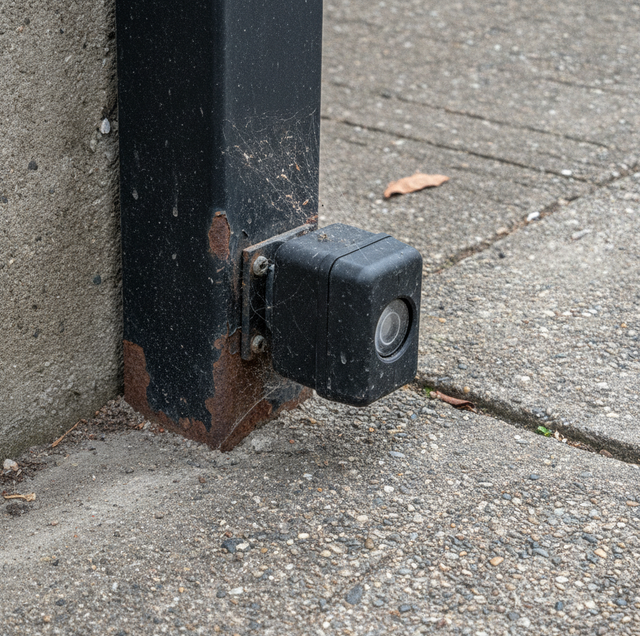
Automatic gates carry photo-eyes, and sometimes a safety edge, whose only job is to stop the gate from closing on a person, pet, or car. When one of these is blocked, dirty, misaligned, or triggered, the operator concludes something is in the path and refuses to complete the cycle. Classic sign: the gate starts to close, then stops and reverses. It's doing exactly what it was designed to do. A spider web across a lens, a bumped bracket that knocked the alignment off, or road film on the eye can all trip it. Cleaning both lenses and getting them aimed back at each other usually clears it.
4. An Obstruction In The Path
Sometimes, nothing is wrong with the electronics at all; something is physically in the way. On a slide gate, debris in the V-track will stop travel. On a swing gate, a rock, a fallen branch, or built-up mud in the hinge arc does the same. Standing water that turns to muck, or landscaping that's crept into the swing path, will fight the operator. The tell here is different from a sensor problem: instead of reversing cleanly, the gate strains, slows, and stops partway while the motor works against the load.
5. Off The Track Or A Broken Hinge
This is the mechanical failure that gets mistaken for a dead motor. On a slide gate, a worn roller or a failed wheel lets the gate jump its V-track and bind, or drag so hard that the operator can't move it. On a swing gate, a broken or sagging hinge throws the geometry off so the operator can't complete its arc. In both cases, the motor may be trying its hardest and getting nowhere. If you hear the operator running but the gate isn't tracking smoothly, check the rollers, track, and hinges before assuming the motor died.
6. Control Board Or Limit Switch
Limit switches are the small sensors that tell the operator where "fully open" and "fully closed" actually are. If one drifts out of position, the gate stops short of finishing its travel, opening or closing only partway, even with the path clear. A control-board fault can produce stranger behavior: no response, erratic movement, or a gate that ignores commands it used to obey. Both of these live inside the operator housing and are pro-territory.
What You Can Safely Check Yourself
A handful of checks are truly homeowner-safe and worth doing before you call anyone.
- Confirm power: Look at the breaker feeding the gate and reset it if it's tripped. Check that the low-voltage charger has power and, on a solar system, that the panel is clean and not shaded.
- Swap the remote battery and test again. If a spare remote or the keypad works, you've found your answer.
- Clean and realign the photo-eyes: Wipe both lenses and make sure they're pointed straight at each other. This one fixes a surprising share of "won't close" complaints.
- Clear the path: Sweep the slide track, pull debris and mud out of the swing arc, and remove anything the gate might be fighting.
- Use the manual release: Every automatic gate has one, so you're never truly locked in or out during a failure.
One thing to leave alone completely: the safety sensors themselves. It's tempting to bypass a photo-eye that keeps stopping the gate, but that removes the crush protection the gate depends on.
When To Call A Pro
Some work sits behind the operator housing or involves the electrical side, and that's where a technician takes over. Control-board diagnosis, operator repair or replacement, limit-switch adjustment, wiring faults, and getting a slide gate back on its track are all pro jobs. So, is any battery or charger work you're not comfortable with?
The reason to hand these off isn't only skill. An automatic gate has real crush and entrapment zones, and it can carry serious force. A technician diagnoses the fault without standing in the gate's path or disabling the safety systems that prevent it from closing on someone. If your gate is dead, stuck off its track, or straining and stopping, get through with the manual release and let a pro find the broken link.
A Quick Way To Read The Symptom
You can often narrow the cause before anyone opens a panel, just by how the gate misbehaves:
- Dead, no lights, no response points at power: breaker, fuse, battery, or charger.
- Starts to close, then reverses, or refuses to close points at the safety sensors.
- Strains, slows, and stops at partway points at an obstruction or a mechanical bind in the track or hinge.
Those three patterns cover the large majority of calls, and each one leads you to a different link in the chain.
Frequently Asked Questions
Check the power first, but don't trust a resting voltage reading alone. A weak battery can show normal voltage at rest and then collapse under the load the motor draws, so a gate that clicks or lurches weakly and quits often has a failing battery even when a meter looks fine. Confirm the breaker and the charger, and treat that click-then-die behavior as a battery on its way out.
That's the safety system working as intended, and the photo-eyes will tell you which one to check. Each eye has a small LED indicator: a steady light usually means it is aligned and seeing its partner, while a blinking or dark light means that eye is blocked or misaligned. Read the lights, then clean or re-aim the eye that isn't steady rather than guessing at both.
Every automatic gate has a manual release, usually a key or a lever that disconnects the operator from the gate so you can move it by hand. That's your way in and out during a power outage or a motor failure, and it holds you over until the gate is repaired.
That often points to a limit switch out of position or an obstruction. Limit switches come in two styles: magnetic, in which a magnet on the gate passes a fixed sensor, and mechanical, in which a lever or cam trips the switch. A magnet that has slipped along the gate or a bent mechanical arm is a common reason travel stops short of "fully open" or "fully closed".
A slide gate is driven either by a rack-and-pinion, a toothed rack along the gate meshing with a gear on the operator, or by a chain. A bent tooth on that rack, or debris packed into the gear teeth, can cause the two to mesh poorly and bind. Along with a rock in the V-track or a worn roller, check the rack and pinion before assuming the motor failed, since binding can stall an operator that's otherwise fine.
No. The photo-eyes and safety edges are there to prevent the gate from closing on a person, pet, or car, so bypassing them removes the crush protection the gate is designed around. If an eye trips in bright sun or during rain, the real fix is often a hood or shade over the lens, or clearing moisture that fogged it, not disabling it. A sensor that keeps tripping should be cleaned, realigned, or repaired.
Book a gate diagnostic — get your automatic gate opening and closing reliably again. Sunset Gates serves Tempe and the East Valley. Call (480) 210-1572.
