
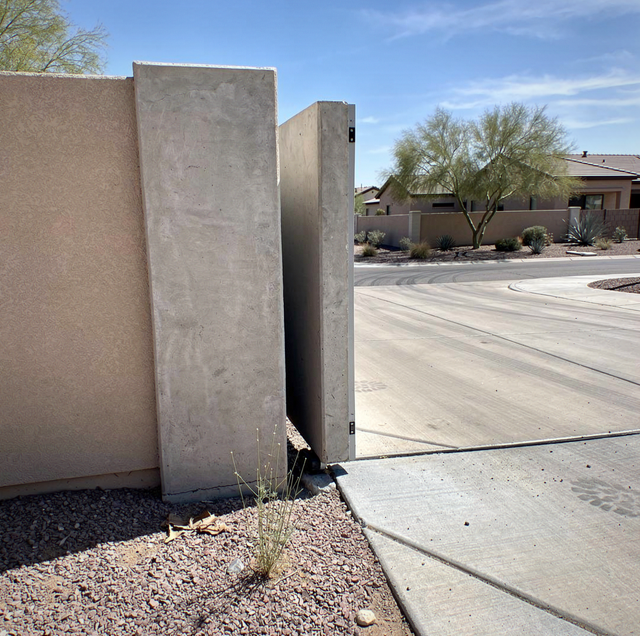
Width alone rarely defeats a stock gate. What defeats it is an opening that sits out of square, an opening that climbs or cross-falls under the gate's path, or an opening hemmed in by something that will not move: a block pillar tied into a wall, a retaining wall already carrying load, a meter pedestal at the driveway edge.
Quick Answer: Usually yes, and the exceptions are about room, not width. Out-of-square pillars, grade across the opening, and span change the frame, the posts, and the hardware, but only a missing swing path or backrun rules a gate out.
Those conditions look similar from the street, and each lands on a different part of the build. Out of square is a frame geometry problem. Grade is a clearance and travel problem. A fixed obstruction is a room problem, and no amount of steel adds room.
A shop that cuts its own steel can build to almost any opening, so the answer to the fit question is nearly always yes. What the opening governs is the frame geometry, the posts, and the hardware, and a short list of measurements settles all three.
The Measurement You Quote Is Rarely the One That Matters
A single opening yields more than one width depending on what the tape is spanning, and those numbers are not interchangeable.
The clear opening: The narrowest gap the gate has to fill, taken between the two faces that will carry it, at gate height. It is almost never the width of the concrete slab, which runs wider than the pillars and flares toward the street.
Post to post: The working dimension a shop draws to, because a gate is never built to the full clear opening. The leaf needs a hinge gap on one side and a latch gap on the other, and both must remain open throughout the full swing and at rest. Squeeze them, and the gate binds on the pillar the first time the post rotates or the leaf sags.
The space the leaf needs: A swinging leaf does not stay inside the opening. It sweeps a quarter circle whose radius is the leaf width plus the hinge offset, and anything inside that radius gets hit: a planter, a parked car, a step down into a courtyard. Homeowners measure the gap and forget the sweep.
Out of square quietly breaks all three numbers. Block pillars get built plumb and still end up out of parallel, laid to a string line that followed a driveway edge that was never straight. Put a rectangular leaf into an opening whose sides are not parallel and the gap along one edge becomes a wedge, tight at the bottom and open at the top. The eye reads that wedge long before it reads the gate.
Slope Runs Two Directions, and Each Fights a Different Gate
Grade at a driveway opening runs two ways, and a homeowner at the curb usually notices only one of them.
Rise and fall along the drive: A swing leaf pivots on a vertical axis, so its bottom rail travels at a fixed height above the hinge point through the entire arc. If the drive climbs away from the opening, the ground rises into that arc while the rail stays where it is. Clearance then has to be set at the highest ground the rail crosses, which leaves the gap at the closed position larger than anyone wants. On a steep enough rise, the leaf cannot open into the driveway at all.
Cross-fall across the opening: A rolling leaf travels a horizontal path. Its bottom edge is at one height, while the ground beneath it slopes from one side of the opening to the other, so the gap under the gate is tight on the high side and open on the low side. The same cross-fall sets the two carrying points at different heights, so the level line on the wall and the level line on the gate are distinct.
Both slopes are numbers that somebody takes on-site at more than one point, because a driveway rarely falls at a steady rate.
Span and Weight Set the Ceiling on a Single Leaf
A leaf's weight acts through its center of gravity toward the middle of the span, so a hinge always holds its load at the end of a lever arm. Widen the leaf, and two things grow at once: the weight itself and the horizontal distance from the hinge line to where that weight acts. Load at the top hinge climbs faster than the width does, which is why a gate a foot wider is not a foot's worth of extra work.
Infill changes that number as much as width does. An open picket leaf and a leaf with a solid panel behind the same pattern fill the same opening and are nowhere near equal in weight. Solid infill also gives wind a surface to push on, and that load does not follow the weight. It acts horizontally, through the center of the leaf's area rather than its center of mass, and it puts the post into bending and twist on axes the dead load never touches. That is why solid infill drives post size and footing depth beyond what weight alone would require.
That is where one leaf stops being the sensible answer. A single-car opening is ordinary territory for a single swinging leaf; at a two-car opening, fabricators generally start proposing a pair of leaves instead, because hinge load and post size have grown beyond what one hinge line and one pillar can carry. Splitting the span, or moving the leaf onto rollers so the opening carries none of it, is how width is handled past that point, and which of those an opening can take depends on the room behind it and the way the ground falls. The gate stops being the limiting part. The thing holding it up becomes the limit.
The Gate Is Only as Square as What Carries It
The leaf hangs from one side of the post, so the post carries the load straight down and rotates at the same time: the load at the end of that lever arm tips the post's top toward the opening while lifting its base away.
Overturning force grows with span, with weight, and with wind. So as a gate gets wider, the post section gets heavier, the depth it reaches increases, and the mass of concrete around it increases. A decorative block pillar and a pillar built to carry a gate can look identical from the street: the one carrying a gate has a continuous interior running down into a footing, and that footing has to sit in soil that will hold it. Caliche layers, loose backfill left from the original driveway cut, and soil that changes volume as its moisture changes all change what the footing has to be.
This belongs in a conversation about fit, rather than one about longevity, because of alignment. A leaf can be built dead square and still hang crooked if the post carrying it shifts a fraction of a degree. Over a long span, a small angular movement at the post appears as a large gap error at the latch, multiplied by the leaf's width. The wider the gate, the less post movement it tolerates.
Where Fabrication Helps and Where the Ground Decides
Plenty of what makes an opening odd gets answered in steel. A raked rail follows a grade line, so the gate's top or bottom edge runs parallel to an unlevel driveway while the frame stays square. A stepped picket line lets picket tops step down alongside a block wall built in steps. A tapered leaf, deeper at one end, fills an opening whose sides are not parallel without leaving a wedge of daylight. A cantilever arrangement carries a sliding leaf on rollers set back behind the opening, so nothing crosses the driveway surface. Hinge geometry gets drawn rather than bought: an inclined pivot axis makes the leaf rise slightly as it swings, which is how a gate clears ground that comes up under it.
What steel cannot do is make room. If the wall behind the hinge side stands where the leaf needs to be at ninety degrees, the leaf cannot go there. If there is no clear run behind the opening for the gate to retract into, a sliding leaf has nowhere to go. Water goes where the grade sends it, and a gate and its posts sit in that path.
One constraint has nothing to do with geometry. Some openings are subject to restrictions recorded against the property or set by a community association, which can govern height, setback, and sometimes materials. Confirm what applies to your address before design work starts, because that is cheaper to learn at the drawing stage than on install day.
What a Site Measure Settles
The work starts with someone standing in the opening with a tape measure, a level, and a camera, because most of what governs the build is not a single number.
A site measure takes the clear opening at its tightest point and the out-of-square in actual fractions of an inch. It takes spot heights across the opening and back along the drive, so the rise and the cross-fall become two known numbers. It records what stands behind the opening on each side, how far back and how tall, which settles whether a leaf has anywhere to go. It looks at what the pillars actually are and whether they can carry what you want. It notes where water crosses the opening after a hard rain, because that decides where a footing can go.
If automation is part of the plan, the measure settles where power can reach and what the operator asks of the gate, because a gate meant to be driven is designed around its operator from the first drawing.
An automated gate can trap a person or a vehicle. A gate built for automation is designed around the operator and safety devices from the start; adding an operator to a gate never meant for one is a conversation with your installer.
What you get back is the gate the opening requires: the leaf configuration, the posts it will hang on, hardware sized to the span, and the places where the ground sets a limit no steel can move.
Frequently Asked Questions
The shop wants the opening straight on from the street, each pillar from the side, and a shot down the drive in both directions so the grade shows. Note what each pillar is built of, whether it ties into a wall, and how tall it stands at the cap. If you do send a measurement, keep the tape taut, because a drooping tape reads longer than the true span.
Yes, and it is common where a wall stepped down a grade. The frame gets squared to itself, while the hinge hardware on one pillar and the latch hardware on the other are set to their own pillar's height independently. The gate's top line is then a drawing-stage decision.
It matters more than most homeowners expect. A double gate usually needs a receiver set into the driveway surface for its drop rod, and posts need holes of their own. Locate irrigation lines, low-voltage lighting runs, and any conduit crossing the opening, and point them out at the measure.
No. A wide leaf that is balanced and hung on hardware sized for it stays workable by hand, and plenty of homeowners choose that on purpose, because an operator puts a control board and electronics in full sun on a circuit exposed to surges. Say so at the design stage if you might automate later.
Coating happens in a shop, in a booth and an oven with fixed interior dimensions, so a leaf longer than that oven gets handled differently. Ask how an oversized leaf will be finished, because a multi-coat finish is what protects the steel from hard sun and alkaline soil.
Often, and the reason is sequence. If the opening needs new posts or rebuilt pillars, final dimensions cannot be taken until those are set and cured, so the work runs in two stages with a wait between them. An opening whose carrying points already exist skips that wait.
Send us the opening you are wrestling with — out of square, on a grade, or boxed in by a wall that will not move, and a gate can be drawn to it. Sunset Gates serves Tempe and the East Valley. Call (480) 210-1572.