Your Gate Has a Lifespan — Here's How to Know When It's Time to Replace It in Phoenix
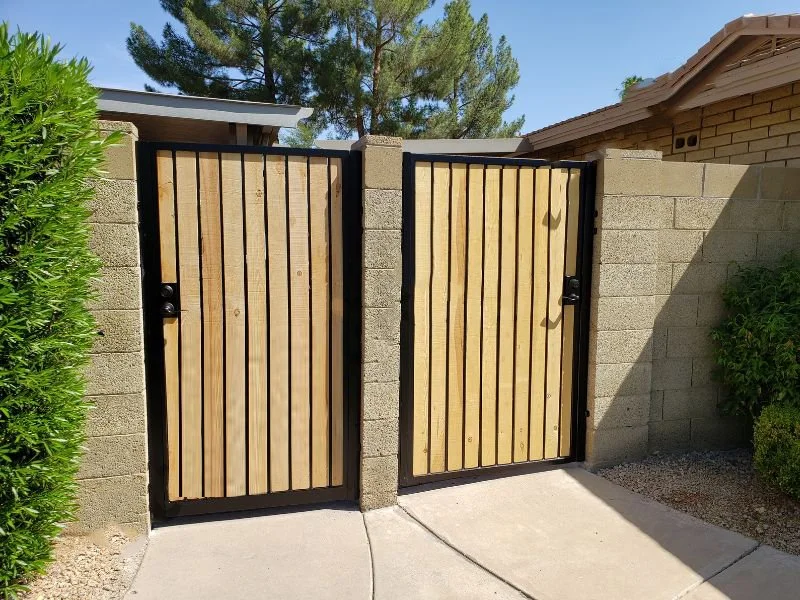
Sagging, rusting, or misaligned gates are more than eyesores — they're liabilities.
Every gate — regardless of material, design, or original installation quality — has a finite useful life. Wood gates warp and rot. Prefab metal gates corrode at their weld points and hinge connections. Even high-quality custom iron gates eventually reach a point where the economics of continued repair no longer make sense relative to the cost of replacement.
For homeowners in Tempe, Mesa, Scottsdale, Chandler, Gilbert, and the broader East Valley, knowing when that point has been reached — and acting on it decisively rather than continuing to invest in repairs — is a practical financial decision as much as an aesthetic one. This guide covers the most reliable indicators that replacement is the right call, what the replacement process looks like, and what upgrade options are worth considering when you do make the move.
The Six Most Common Signs Your Gate Needs Replacement
1. Persistent Sag That Returns After Adjustment
Some gate sag is a hardware adjustment issue — a loose hinge bolt, a latch that needs repositioning, or a post that has shifted slightly. But when a gate sags back to misalignment within weeks or months of being adjusted, the underlying cause is structural. Either the posts have shifted, the hinge weld points have fatigued and cracked, or the gate frame itself has racked out of square under years of operational stress.
Repeated adjustment without addressing the root cause is a cycle that costs money without solving the problem. When sag recurs after professional adjustment, the conversation should shift to replacement.
2. Rust That Has Penetrated Beyond the Surface
Surface rust on a wrought iron gate — light oxidation that has not penetrated through the powder coat or paint layer — can often be addressed with surface preparation and refinishing. But rust that has penetrated into the steel substrate, that has caused visible pitting or section loss in the metal, or that appears along weld seams indicates corrosion that cannot be stopped by surface treatment alone.
In Arizona, rust formation that penetrates the base metal typically indicates either a finish failure that went unaddressed for an extended period or fabrication with inadequately prepared steel. Either way, the metal's structural integrity is compromised, and the gate's service life is effectively over.
3. Hinge Failure or Chronic Hinge Problems
Hinges that fail repeatedly — or that show progressive cracking, elongation of the hinge pin bore, or deformation of the hinge leaf — are telling you something important about the post or pillar they are attached to. Hinges do not typically fail in isolation. When they fail repeatedly, it usually means they are absorbing movement from a post that is not staying plumb, or that the original hinge specification was inadequate for the gate's actual weight.
Pro tip: Before attributing chronic hinge problems to the hinges themselves, check the post for plumb. A post that has shifted even a fraction of an inch out of plumb creates lateral stress on hinges that they are not designed to handle. Replacing hinges on a shifted post will produce the same failure again. Addressing the post is what resolves the problem — and at that point, a complete replacement is often the most cost-effective path forward.
4. A Wood Gate in Arizona's Climate
Wood gates are fundamentally unsuited to the Greater Phoenix metro environment. The combination of extreme UV exposure, sustained high heat, very low humidity during dry months, and monsoon moisture cycling creates conditions that accelerate wood degradation at a rate that most homeowners significantly underestimate when the gate is first installed.
Checking, cracking, warping, and surface deterioration begin within a few years of installation in the Phoenix metro. By ten years, most wood gates in this climate have deteriorated beyond the point of economical repair. If your wood gate is exhibiting these symptoms, the question is not whether to replace it — it is what to replace it with.
5. A Prefab Gate That Never Fit Correctly
Many Phoenix-area homeowners are living with prefab or off-the-shelf gates that were installed as an economical solution and have never quite fit the opening or matched the home the way they should. Gaps at the post, a finish that has faded unevenly, hardware that was not rated for the gate weight, a style that was available rather than appropriate — these are the hallmarks of a prefab installation.
When a homeowner reaches the natural replacement decision point with a prefab gate, upgrading to a custom wrought iron installation represents not just a repair but a genuine property improvement that changes the character of the entry.
6. An Outdated Design After Property Renovation
Properties change. Landscaping matures, driveways are repaved, exterior paint is updated, and additions are built. A gate that was a reasonable fit for the property five or ten years ago may now look dated or mismatched relative to everything around it. When a gate's design is no longer in harmony with the property's current character, replacement with a custom gate designed for the current architecture is the right investment.
Evaluating What Stays and What Goes
Not every gate replacement requires tearing everything out and starting from scratch. An important part of the professional site evaluation is determining which elements of the existing installation — posts, block pillars, concrete work — are structurally sound and can be incorporated into the new installation, and which elements need to be replaced or modified.
At Sunset Gates, we assess every existing structure honestly. Block pillars that look solid from the outside sometimes have deteriorated mortar, cracked cores, or improperly placed hinge anchors that make them unreliable for a new gate installation. We identify these issues before the project begins and include any required structural work in the project scope — not as a surprise add-on after the old gate is already removed.
Pro tip: When getting replacement proposals from gate companies, make sure each proposal clearly addresses what happens to the existing posts or pillars. A proposal that does not mention existing structure assessment either assumes everything can be reused — which may not be true — or plans to discover the issue on installation day. Neither is acceptable.
What to Upgrade When You Replace
A gate replacement project is also a natural opportunity to reconsider the gate configuration. Homeowners frequently use the replacement as a chance to make improvements that the original installation did not include.
Widening the Opening
If vehicle access has been a recurring inconvenience — tight clearance for trucks, trailers, RVs, or boats — replacement is the time to widen the opening. Combining opening expansion with gate replacement is more cost-effective than doing the two projects separately.
Converting Single to Double
A wider, more symmetrical two-panel double gate often makes sense for driveways that have always had a single gate. The visual improvement is significant, the functional clearance increases, and the project complexity of converting during a replacement is much lower than it would be as a standalone modification.
Upgrading to Custom Design
Perhaps the most important upgrade available at replacement time is moving from a prefab or generic gate to a custom-designed iron gate that is actually appropriate for the property's architecture. This is not just an aesthetic improvement — it is a structural one. Custom gates are fabricated to correct dimensions, with hardware specified for the actual application, on posts engineered for the specific conditions.
FAQs
-
The most reliable indicators for Greater Phoenix homeowners are persistent sag that returns within months of professional adjustment — suggesting footing failure rather than a hardware issue — rust that has penetrated beyond the finish layer into the base metal, chronic hinge failure that repeats after replacement, a wood gate that has warped or rotted beyond the reach of surface treatment in Arizona's climate, and a gate whose design was never appropriate for the property's architecture. When any of these conditions are present in Tempe, Mesa, Scottsdale, or East Valley properties, replacement delivers better long-term value than continued repair investment.
-
The Greater Phoenix metro delivers a combination of degradation factors that few other climates match: 300-plus days of direct UV exposure annually, summer temperatures exceeding 110 degrees Fahrenheit, monsoon-season moisture cycling that produces rapid humidity swings after months of extreme dryness, and expansive soils that exert lateral force on post and footing systems seasonally. Wood gates in particular deteriorate at rates that surprise homeowners who moved to Tempe, Chandler, or Mesa from more temperate regions — a gate that would last twenty years in the Pacific Northwest may need replacement in eight to ten years in Arizona.
-
In many cases, yes — but reuse requires physical on-site assessment, not assumption. Block pillars at residential entries throughout Scottsdale, Chandler, Paradise Valley, and the East Valley can appear structurally sound while having deteriorated mortar joints, cracked cores from thermal cycling, or inadequate hinge anchor reinforcement. Sunset Gates evaluates every existing pillar during the on-site assessment and provides a clear, honest recommendation on reuse, modification, or replacement before any work is scoped or priced.
-
In the short term, replacement is typically a larger upfront investment than a single repair. Over time, however, the comparison shifts significantly. Repeated repairs on a deteriorating gate — particularly one in Tempe, Mesa, or the East Valley that has footing, post, or structural issues — accumulate costs without resolving the underlying problem. A custom wrought iron gate replacement on properly engineered posts and footings delivers decades of reliable performance with minimal maintenance, making it the lower long-term cost option for most Phoenix-area replacement scenarios.
-
Yes. Sunset Gates handles gate replacement projects throughout our Greater Phoenix service area, including Tempe, Mesa, Scottsdale, Gilbert, Chandler, Phoenix, Paradise Valley, Ahwatukee Foothills, Fountain Hills, Glendale, Sun Lakes, Queen Creek, and Apache Junction. Every replacement project includes a free on-site assessment, a complete written proposal covering all scope items, and custom fabrication at our Tempe shop.
Serving the East Valley and Greater Phoenix Metro
Sunset Gates handles gate replacement projects for homeowners and commercial property owners throughout Tempe, Mesa, Scottsdale, Gilbert, Chandler, Phoenix, Paradise Valley, Ahwatukee Foothills, Fountain Hills, Glendale, Sun Lakes, Queen Creek, and Apache Junction.
Contact Sunset Gates to schedule a free on-site assessment. We will evaluate your existing gate and site conditions, give you an honest recommendation on repair versus replacement, and provide clear, complete pricing for the work your property actually needs.