
Manual vs. Automatic Driveway Gate: Which Fits Your Life
Quick Answer: If you pass through several times a day, or the gate is heavy and wide, automation usually pays for itself in convenience and safety. If you pass through occasionally and value the fewest moving parts, a well-built manual gate is hard to beat. Your driveway's slope, how it swings or slides, and whether power reaches the gate often decide it before preference does.
You pull up to the driveway, put the truck in park, get out, swing a heavy iron gate open, drive through, get out again, and close it behind you. Do that twice a day for a week, and the appeal of a remote button becomes obvious. Do it twice a month, and the same button starts to look like a motor you now have to maintain. The right answer is not the same for every driveway, and it rarely comes down to preference alone. It comes down to how often you pass through, how your gate moves, whether power reaches it, and what you are willing to maintain.
Here is how manual and automatic driveway gates actually differ, and which factors decide it.
Start With How Often You Pass Through
The single biggest driver is traffic. A gate you open and close a dozen times a day is a chore when it is manual and a relief when it is automatic, especially in bad weather or after dark when nobody wants to leave a running vehicle to wrestle iron. A gate that mostly stays shut and opens a couple of times a week is a different calculation, because every day it sits closed, an automatic gate is a motor, a control board, and a set of sensors doing nothing but aging in the heat.
Frequency also changes the safety math. The more times a day a gate cycles with vehicles, pets, and kids moving through the opening, the more an automatic gate's standard safety features earn their place, and the more a manual gate depends on a person paying attention every single time.
How the Gate Moves Changes Everything
Before automation even enters the conversation, the gate's geometry sets the terms. A driveway gate either swings on hinges or slides along a track, and the two behave very differently once a motor is attached.
A swing gate needs a clear arc to open into, either into the property or out toward the street, and that arc has to stay clear of parked cars, planters, and the ground itself. Here is where slope matters: if the driveway rises toward a gate that swings inward will bind against the rising grade partway through its arc. On a sloped approach, that often forces the gate to swing the other direction, or pushes the decision toward a slide gate instead. Automating a swing gate means matching the operator to the leaf length and weight, because a long, heavy leaf puts far more load on the arm than a short light one.
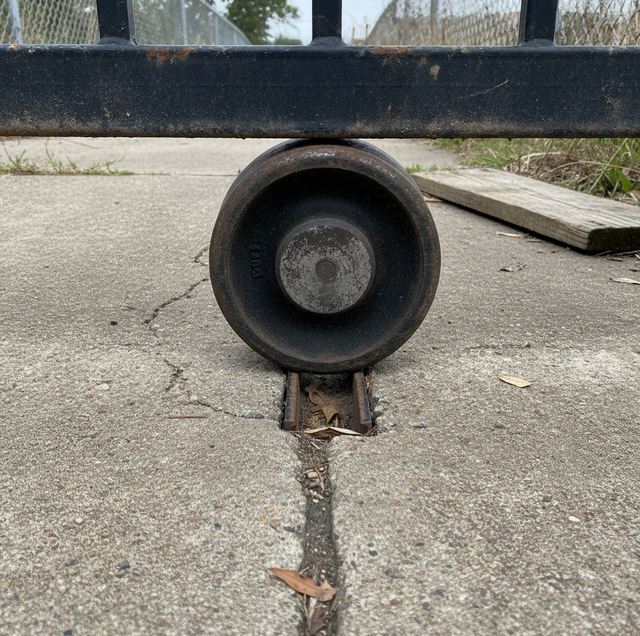
A slide gate needs the opposite: room to the side for the gate to travel into, and a level, debris-free path along its track. It does not care about slope across the opening, the way a swing gate does, which is part of why sloped and tight lots often end up with sliders. What a slider does care about is the track and rollers staying clean and true, because grit and a bent track will fight the motor every cycle.
The short version: geometry frequently makes the manual-versus-automatic call for you. A gate that cannot swing cleanly on a slope may need to be a slider, and the slider's operator, room, and track then shape everything downstream.
Power, Operators, and Staying Unstuck
An automatic gate needs an operator, the motor and mechanism that moves it, and that operator needs power. Most run on low-voltage control circuits, which is why so many systems can be paired with a battery backup, so an outage does not leave you stranded on the wrong side of your own gate. That battery backup is not a luxury feature. It is the difference between a brief inconvenience and being stuck in the driveway when the grid goes down.
Power availability is a real hurdle on large lots, where a driveway gate can sit a long way from the nearest outlet or panel. Running a new circuit out to a distant gate is sometimes the most involved part of the whole job. This is where a solar-panel option becomes useful: a solar setup charges the operator's battery from the sun, which fits a spot with strong year-round light and no convenient power nearby. Manufacturers position solar as a way to skip the trenching, and for the right remote gate, it can be, though how well it holds up depends on the panel being sized for the gate's daily cycle count and kept clear of dust.
A manual gate, by contrast, needs no power, no operator, and no backup plan for an outage. That simplicity is its whole argument.
Access Control and the Safety Point That Matters Most
Automation is what makes access control possible. A keypad lets guests in with a code, a remote or phone app opens the gate from the vehicle, and a loop sensor or exit sensor buried in the driveway can trigger the gate as a car approaches from inside. None of that exists on a manual gate, where access control means someone physically walking out to the latch.
The safety features are the part not to gloss over. A properly set up automatic gate uses photo-eyes, an infrared beam across the opening that stops and reverses the gate if something breaks the beam, so the gate will not close on a car, a pet, or a child standing in the gap. Many systems add a safety edge, a pressure-sensitive strip that reverses the gate the instant it contacts an obstruction, and auto-reverse behavior so a gate meeting resistance backs off rather than forcing through. These are standard, expected features on a well-built automatic gate, not upgrades to skip. A manual gate has none of them and none of the risk either, because it only moves when a person is pushing it and watching the opening.
Security, Curb Appeal, and What Iron Signals
Both manual and automatic iron gates raise the security and presence of a property. A closed iron gate is a real physical barrier and an obvious visual signal that the property is defined and defended, and a well-built one adds to how the whole frontage reads from the street. Automation adds convenience-driven security on top: a gate that closes itself every time is a gate that is actually closed, rather than one left open because pushing it shut was one errand too many. The failure mode of a manual gate is human: it gets left open. The failure mode of an automatic gate is mechanical: something in the system stops working.
Maintenance Is the Real Trade-Off
This is where the two paths separate for good. A manual iron gate has hinges or rollers, a latch, and a finish, and that is nearly the whole list of things that can wear. Keep the pivots and track clean, keep the powder coat intact, and a manual gate can run for years with very little attention.
An automatic gate adds a motor, a control board, sensors, and hardware that now cycles under power far more often than a hand-operated gate ever would. Every one of those additions is something that can eventually need service. Heat and dust make this concrete. Heat stresses the electronics in a control board and shortens the life of a battery, fine dust works into rollers, hinges, and the moving parts of an operator, and seasonal moisture and blowing grit reach connections and photo-eye lenses that a manual gate simply does not have. None of this makes automation a bad idea, since plenty of automatic gates run for years. But it is honest to say an automatic gate is a system to maintain, while a manual gate is closer to a single well-built part.
Think of it like the difference between a bicycle and a car. Both get you down the driveway, but one has a drivetrain, a battery, and electronics that ask for attention, and the other mostly asks that you keep it clean and oiled.
Manual vs. Automatic at a Glance
| Factor | Manual gate | Automatic gate |
|---|---|---|
| Best for | Occasional passes, simplest possible setup | Frequent daily use, hands-free access |
| Power needed | None | Operator plus power, or solar with battery |
| Access control | Physical latch only | Keypad, remote, app, loop/exit sensor |
| Safety features | None; depends on the person | Photo-eyes, safety edge, auto-reverse |
| Slope tolerance | Swing binds on grade; slider is more forgiving | Same geometry, plus operator matched to weight |
| Outage behavior | Always works | Battery backup and manual release key |
| Maintenance load | Hinges/rollers, latch, finish | All of that plus motor, board, sensors |
| Failure mode | Left open by a person | A component stops working |
Match It to Your Driveway, Not the Brochure
Put it together, and the decision follows a few honest questions. How many times a day do you actually pass through? Does the gate swing on a slope that fights it, or slide along a level run with room to the side? Does power reach the gate, and if not, is solar realistic for that spot? And how much of a system are you willing to maintain against heat and dust? A busy daily driveway with power nearby leans automatically almost every time. A quiet, occasionally used gate on a lot with no easy power leans manual. Most driveways answer the question themselves once you weigh use, layout, power, and upkeep together.
Frequently Asked Questions
Often yes, but a retrofit has conditions. The gate has to be within the weight and length range the operator is rated for, and the hinge post or slide track and its posts have to be strong enough to take the added cycling load without flexing. A gate hung on a post that already moves or a frame that racks is a poor candidate until that is fixed first, because a motor will only expose the weakness faster. And power has to reach the gate, whether by a new circuit or a solar setup. When those three hold (weight, structure, and power), automating a sound manual gate is a common project rather than a rebuild.
A well-set-up automatic gate handles an outage in two ways. If it has a battery backup, the low-voltage system keeps running for a period on stored charge, so you may not notice the outage at all until the battery runs low. And every operator includes a manual release, usually a key-operated disconnect, that lets you free the gate from the motor and move it by hand. Knowing where that release is and how it works before you need it is the whole point, because an outage is exactly when you do not want to be learning it.
Backup and solar batteries are consumables, not permanent parts, so plan on replacing one every few years, and sooner in relentless heat, which is hard on any battery. The signs yours is fading are a gate that opens more slowly than it used to, a unit that beeps or throws a low-battery code, or one that dies partway through a cycle during an outage. Swapping it is routine service rather than a rebuild, but a tired battery is the single most common reason a reliable automatic gate suddenly acts up, so it pays to track the install date instead of waiting to get stranded at the driveway.
Three work together. Photo-eyes send an infrared beam across the opening and stop and reverse the gate the instant something breaks the beam. A safety edge is a pressure strip along the gate's leading edge that reverses it the moment it touches an obstruction. And auto-reverse is the operator's own logic to back off when it senses resistance rather than forcing through. On a well-built automatic gate, these are standard, and it is worth confirming they are present, tested, and aimed correctly, since a misaligned photo-eye protects nothing.
Yes, and this is not a place to under-spec. An operator is rated for a range of gate weight and, for swing gates, leaf length, because a longer, heavier leaf puts far more load and momentum on the arm or motor. Pairing a heavy iron gate with an operator meant for a light gate means the motor works at its limit every cycle, wears early, and struggles in heat. Matching the operator to the true weight and span of the gate is what lets it cycle for years without laboring, which is one reason gate weight is worth knowing before choosing automation.
In practice, usually yes, though not because the barrier is stronger, since a well-built iron gate is the same either way. The security comes from behavior. An automatic gate closes itself after every car, so it is never left standing open the way a manual gate gets propped for the afternoon, and access control lets you decide who has a code or a remote and revoke it later. A manual gate is only as secure as whoever remembers to latch it. The tradeoff is that a powered gate should have its reversing sensors and safety edge kept in tune, since those are also what stop someone from being caught as it moves.
Get a straight recommendation on manual versus automatic for your driveway — sized to your layout, use, and power so you install it once and right. Sunset Gates serves Tempe and the East Valley. Call (480) 210-1572.
