
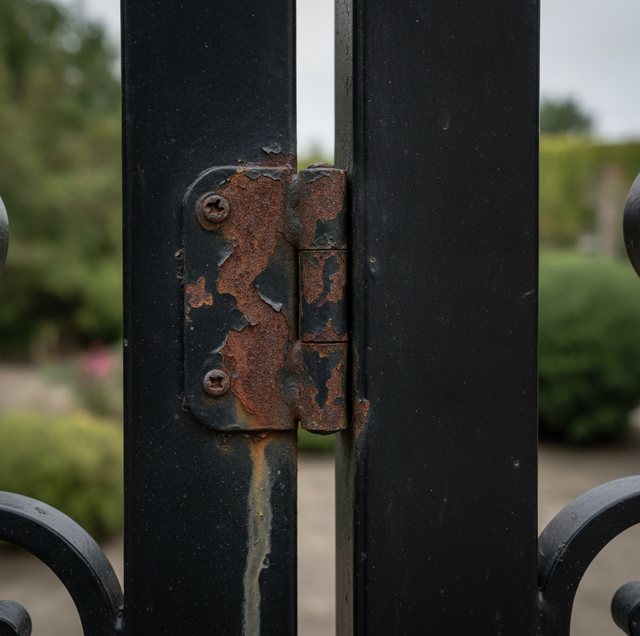
An iron gate is one of the few things on a property that a finish either protects for a decade or fails on within a season. The metal underneath does not change. What sits on top of it is the whole story, and the two common ways to cover iron behave nothing alike once heat, moisture, and sun get to work on them.
The choice usually comes down to powder coating versus wet paint. They look similar from ten feet away. Up close, and a few years down the road, they age in very different directions. Understanding why starts with how each finish is actually formed, not with which one a brochure calls better.
Quick Answer: Powder coating generally lasts longer because it is baked into a thick, hard shell that resists chipping, fading, and rust. Wet paint is a thinner, air-dried film that is far easier to touch up on-site but needs to be redone sooner. Powder wins on durability; paint wins on convenience and in-place repair
How Powder Coating Actually Forms
Powder coating starts as a dry powder, not a liquid. The powder carries an electrostatic charge, and the bare gate is grounded, so the particles are pulled onto the metal and cling evenly to every face, corner, and picket. The gate then goes into a curing oven, where heat melts the powder and chemically cross-links it into one continuous shell that flows around the steel and hardens as it cools.
That baking step is what sets powder apart. The finish is not sitting on the surface waiting to dry in open air. It has been fused into a single thick layer, typically several times heavier than a coat of paint, with no solvents evaporating out and leaving thin spots behind. The result is a hard, uniform skin that shrugs off the small knocks and scrapes a gate takes at a latch, a hinge, or a kid's bike handlebar.
Because the entire process requires an oven, powder coating is done in a shop. The gate travels to the coater rather than the coater coming to the gate. For a piece built in a fabrication shop, that step folds neatly into the build. For a gate already hung and welded into place, the question is whether to move it.
How Wet Paint Behaves Differently
Wet paint is liquid from the can to the wall. It gets brushed or sprayed onto the gate and then dries in the open air as its solvents evaporate, leaving the film. Nothing bakes. The coating that remains is thinner than powder and cures by exposure rather than by heat, which is exactly why it stays flexible for touch-ups but never reaches the same density.
That thinness is both the weakness and the appeal. A thinner film chips at the edges, fades faster under hard light, and does not seal the metal as completely, so it calls for repainting on a shorter cycle. In trade, paint can be applied right where the gate stands. No transport, no oven, no lifting a welded gate off its posts.
Paint also opens up color and sheen choices that a coater may not stock, and it lets you match an existing scheme or change it later without hauling hardware anywhere. Think of powder as a ceramic mug fired in a kiln and paint as a coat of nail polish. One is cooked into a hard body; the other lays a thin skin on top that you can redo whenever you like.
Durability, Fading, and Rust
On raw staying power, powder is the clear leader. The baked shell resists chipping because it is thick and fused rather than layered and dried. It holds color and gloss longer because the pigment is locked into a cured film instead of a thin one that chalks. And it seals more completely, which slows the moisture that starts corrosion on iron.
Powder is not immune, though, and this is the honest limit. Its protection lives at the surface. A deep scratch or gouge that cuts through the coating to bare metal opens a doorway, and moisture that reaches the raw iron there can begin to creep sideways beneath the coating over time. Powder resists rust extremely well across an unbroken surface; it does not defend a wound that reaches the steel.
Paint shares the same vulnerability and adds a thinner starting film on top of it, so it tends to reach the repainting point sooner. The trade-off is that paint fails in a way that is easy to fix, while powder fails in a way that is hard to fix well.
Repair Is Where the Story Flips
Paint's real advantage shows up the day something goes wrong. A chip or scratch in paint can be sanded, spot-primed, and touched up in place with a small brush, and the repair blends acceptably. Some owners knowingly accept paint's shorter service life for exactly this reason: when it fails, it fails cheaply and locally, on the gate, in an afternoon.
Powder does not repair the same way. Because the finish is baked, a genuine fix means recoating the piece back in the shop, which means the gate has to come off and travel again. There are field patch products, but they never match the hardness or the unbroken look of the original cured shell. For a powder-coated gate, prevention and prompt attention to a chip matter more than any patch kit.
So the two finishes trade places depending on what you value. Want the longest life and the least maintenance, and can send the gate out to be coated? Powder. Want the freedom to fix, recolor, and refinish in place without ever moving the hardware? Paint.
The Comparison at a Glance
| Factor | Powder Coating | Wet Paint |
|---|---|---|
| Durability/longevity | Longest; thick baked shell resists wear | Shorter; thinner film needs redoing sooner |
| Touch-up/repair | Hard; requires recoating in a shop | Easy; sand and touch up in place |
| Where it is applied | In a shop, in a curing oven | On-site or in a shop |
| Rust resistance | High over the surface; scratch to bare metal is still a risk | Lower, thinner seal over the same risk |
| Look and color options | Hard, uniform, durable finish | More color and sheen flexibility |
The Part Both Finishes Depend On
Here is the factor that decides more failures than the finish choice itself: surface preparation. Neither powder nor paint bonds to iron that is dirty, oily, or already rusting. The bare metal has to be cleaned first, often by sandblasting down to a sound surface, and iron, in particular, needs a primer or undercoat before the topcoat goes on.
Skip that step, and it does not matter which finish you picked. Any rust, mill scale, or oil left underneath keeps the coating from gripping and gives corrosion a place to spread beneath a topcoat that still looks fine from the outside. A cheap finish over clean, primed steel outlasts a premium finish over a dirty gate every time. Prep is the foundation, and it is invisible once the gate is coated, which is exactly why it gets shortchanged.
What Intense Sun Adds to the Test
Any finish on an outdoor gate is constantly being tested, and two forces do most of the testing on iron. Intense sun and heat work on the topcoat from above, driving the fading and chalking that dulls a color over the years, and here powder's baked pigment tends to hold its color and gloss longer than most wet paints can. Moisture works from the other direction, and it rarely comes from rain alone.
The more common culprit is irrigation. A sprinkler head that clips the base of a gate, or a spray that drifts onto the lower pickets several times a week, keeps the bottom of the metal damp far more often than the weather does. That standing dampness is where rust likes to start, especially at welds and low corners. It is two-sided by nature: the sun stresses the finish from the top year-round, and water stresses it from the bottom every time the system runs. A finish that seals well and holds up to sun handles both better, and a gate positioned or shielded so the spray misses it will outlast one that gets watered daily, no matter what covers it.
Choosing Between Them
Strip away the marketing, and the decision is short. If the gate can travel to a coater and you want the longest life with the least upkeep, powder coating is the stronger finish, and hard sun makes that edge larger, not smaller. If the gate is very large or permanently installed and cannot practically be moved, or if you want the freedom to touch up and recolor in place, wet paint earns its keep.
Whichever you choose, the metal only stays sound if the prep underneath was done right and the low, sprinkler-soaked corners are watched for the first chip. The finish you can see is only as good as the clean, primed steel you cannot.
Frequently Asked Questions
A shop powder finish typically lasts many years before needing redoing, while a wet-paint finish on an exterior iron gate often needs a repaint every few years. Powder also keeps its gloss instead of chalking as early, so the color stays truer between refinishes. The gap widens on a gate that lives outdoors, where the baked shell earns its keep.
Field touch-up powder and matching aerosols exist, but they rarely match the baked finish exactly. So a chip is usually spot-primed and brushed as a temporary fix and then fully recoated later when the gate can go back to the shop. That mismatch is worth knowing when you pick a color, since a hard-to-match shade shows a patch more plainly than a common one.
The bare metal needs a clean profile, an etch or blast pattern, for the finish to key into rather than sit loosely on a smooth face. Welds and seams need extra attention because leftover mill scale or flux there is a common spot where a coating lifts first. Get that profile right and even a modest topcoat grips; skip it and the best finish peels from the weakest seam.
It can. Scratches tend to concentrate at the latch, the hinges, and the bottom rail where the gate gets bumped, so those spots are worth checking first. A dab of matching touch-up over any bare metal stops rust from creeping under the coating before it gets a foothold. Catching a chip early keeps a cosmetic mark from turning into a spreading blister.
Only if it can be transported to a coating shop and fit inside the curing oven, because powder has to be baked to cure. A very large gate or one that is permanently installed may not fit or come loose easily, so those often have to be finished with paint on site instead.
Yes. Strong sun breaks down a wet paint's binder and fades its pigment faster than it does a cured powder's baked pigment. So a gate in full sun holds its color noticeably longer in powder, where it can be shop-coated and cured before it is hung. That difference is most visible on saturated colors, which are the first to look tired once a binder starts to chalk.
Ask about a shop-cured, multi-coat finish built to withstand the sun — get a gate that keeps its color and resists rust for years. Sunset Gates serves Tempe and the East Valley. Call (480) 210-1572.
