
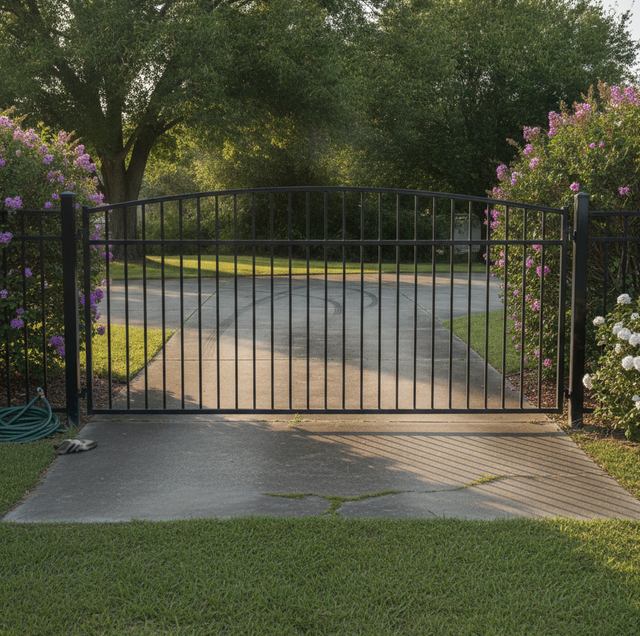
Quick Answer: A standard driveway gate is the main entry, sized for cars and trucks, commonly around a 10-to-12-foot opening and roughly 5 to 6 feet tall. An RV gate is a wider and taller side opening, often 12 to 14 feet or more across, frequently built with no top arch so a tall rig clear, and positioned to feed a side-yard parking pad. The differences that matter are width, vertical clearance, swing versus slide, and heavier posts and hardware.
What a Standard Driveway Gate Is Built to Do
A standard driveway gate lives across your primary entrance. Its job is to close off the drive where cars and trucks come and go, so it gets sized to the vehicles most households own. A common opening runs somewhere in the 10 to 12 foot range, and the leaves usually stand about 5 to 6 feet tall, enough to read as a real barrier and match the wall or pillars on either side.
Because passenger vehicles are short and maneuverable, this gate can carry design features that an RV would never tolerate. A decorative top arch, a horizontal header bar between two pillars, spear-top pickets rising above the frame: none of that interferes with a sedan or a pickup rolling underneath. The whole thing is tuned for a vehicle that turns tight, sits low, and lines up with the opening in a car length or two.
What Changes When the Vehicle Is an RV
Swap the car for a Class A motorhome or a fifth wheel, and every one of those assumptions breaks. A long rig needs a wider throat because it swings through the opening on a much larger turning radius, and its mirrors stick out past the body on both sides. It also stands far taller than any pickup, which means anything crossing overhead is now an obstacle rather than a decoration.
So an RV gate is defined by absence as much as by size. It is wider, often 12 to 14 feet or more, and it is frequently built with no arch and no top bar at all, leaving open sky above the opening so a tall roofline, rooftop air conditioner, or vent stack passes through untouched. It is almost always placed to the side of the house rather than at the front, opening onto a side-yard pad where the rig parks out of view and off the street.
Think of the difference like a household door versus a garage door. Both are openings in a wall, but you would never try to walk a car through the front door, and the reasons have nothing to do with style and everything to do with what has to fit through.
The Five Differences That Actually Matter
Beyond the headline of "bigger," a handful of specific things change between the two gates. These are the points worth settling before anyone starts building.
Width: A car needs room to pass; a long rig needs room to arc through the opening without the tail or the front overhang catching a post. That is why RV openings run so much wider than the drive-front gate you may already have.
Height and clearance: A standard gate can wear a top arch or header. An RV gate usually cannot, because the rig is tall and the opening has to stay clear all the way up.
Swing versus slide: A standard gate almost always swings. An RV gate has a real choice to make here, because a long vehicle changes how much room you have to give up to the gate itself.
Posts and hardware: More width and more height mean more gate, and more gate means more weight and more surface for the wind to push on. The structure holding it up has to grow to match.
Placement and ground: A front gate sits at the existing driveway apron. An RV gate lands wherever the side-yard pad and the approach from the street allow the rig to line up.
Here is how the two compare at a glance.
| Feature | Standard Driveway Gate | RV Gate |
|---|---|---|
| Typical width | ~10 to 12 ft opening | 12 to 14+ ft opening |
| Height/clearance | ~5 to 6 ft, arch or header common | Taller, usually open top, no overhead bar |
| Placement | Main front entry | Side of the house, feeding a side-yard pad |
| Swing or slide | Almost always swing | Swing or cantilever slide, chosen by lot depth |
| Posts and hardware | Sized for a moderate leaf | Heavier posts, deeper set, rated hinges or track |
Deciding Between Them for Your Own Lot
The starting point is not the gate at all; it is the rig. Measure the motorhome or trailer at its widest, including the mirrors, and at its tallest, including anything mounted on the roof, then add a margin for the fact that you will never thread the opening perfectly on every attempt. Those two numbers set the minimum width and clearance the opening has to give you.
After that, the lot decides most of the rest. A short distance between the street and the side pad pushes you toward a slide gate, because a swing leaf that wide needs a large empty arc to open into. A shallow approach off the street changes where the gate can sit and how the rig lines up with it. And in open, windy terrain, wind load is a genuine design factor rather than an afterthought, because a tall, wide gate is a large sail, and steady sun over the years is hard on both the finish and any electronics you add. None of these rules out an RV gate; it just means the build gets tailored to what you park and where you park it.
One safety point belongs here regardless of which gate you choose. If you automate the gate, the operator is an electrical and mechanical installation that belongs with a qualified professional, and it must include proper safety sensors so the gate reverses instead of closing on a vehicle, a pet, or a person. A large moving gate is not a place to improvise.
Frequently Asked Questions
Start by measuring the rig at its widest point, which usually means the mirrors rather than the body, then account for the angle of your approach, since a gate you drive straight into needs less margin than one you enter on a curve. Many RV gates run 12 to 14 feet or more, so a long motorhome or fifth wheel can swing through without a mirror or the tail clipping a post on the way in.
Many motorhomes and fifth wheels stand roughly 12 to 13.5 feet tall, and even a decorative top bar sits lower than a standard garage door header would, so any overhead piece becomes an obstacle rather than a detail. An RV gate answers this by leaving the opening fully open at the top, with no header or arch, so the clearance runs uninterrupted from the ground to open sky. That way, a tall roofline, a rooftop air conditioner, or a vent stack passes through without anyone having to guess at inches.
A cantilever slide gate rolls sideways along a track and needs no arc to open, which suits a short driveway apron where there is little room in front of the gate. A swing gate is mechanically simpler and often less expensive to build, but it has to have clear, unobstructed space to swing into, and that space cannot be occupied by the parked rig or a wall.
Yes. The extra width and sail area of an RV gate call for larger structural posts, commonly heavier steel tubes, set deeper in a concrete footing than a car-gate post would need. Those posts pair with heavy-duty hinges on a swing gate or a rated cantilever roller track on a slide gate. Undersized posts are the reason a wide gate starts to sag at the latch side over time, so sizing them correctly is what keeps the gate level for years.
It can be automated, but the operator has to be rated for the gate's actual weight and width rather than a general residential average, because an undersized motor wears out fast on a heavy gate. A large gate also catches more wind, which the motor has to push through, and which the safety sensors and travel limits must account for so the gate still opens, closes, and reverses reliably.
Leave enough apron and turning radius for the rig to back in or pull straight through without cutting the corner, since a long vehicle that has to crank hard the moment it leaves the road is rough on both the rig and the gate. Before you commit to a spot, check the property setback and any utility easement along that side of the lot. An RV pad and gate often sit near a side lot line, which is exactly where those limits tend to apply, so confirming them first keeps the build from landing somewhere it cannot legally go.
Measure your rig and get a gate built to fit it — no clipped mirrors, no scraped roofs. Sunset Gates serves Tempe and the East Valley. Call (480) 210-1572.
