
Swing vs. Slide Driveway Gate: Which Is Better for You?
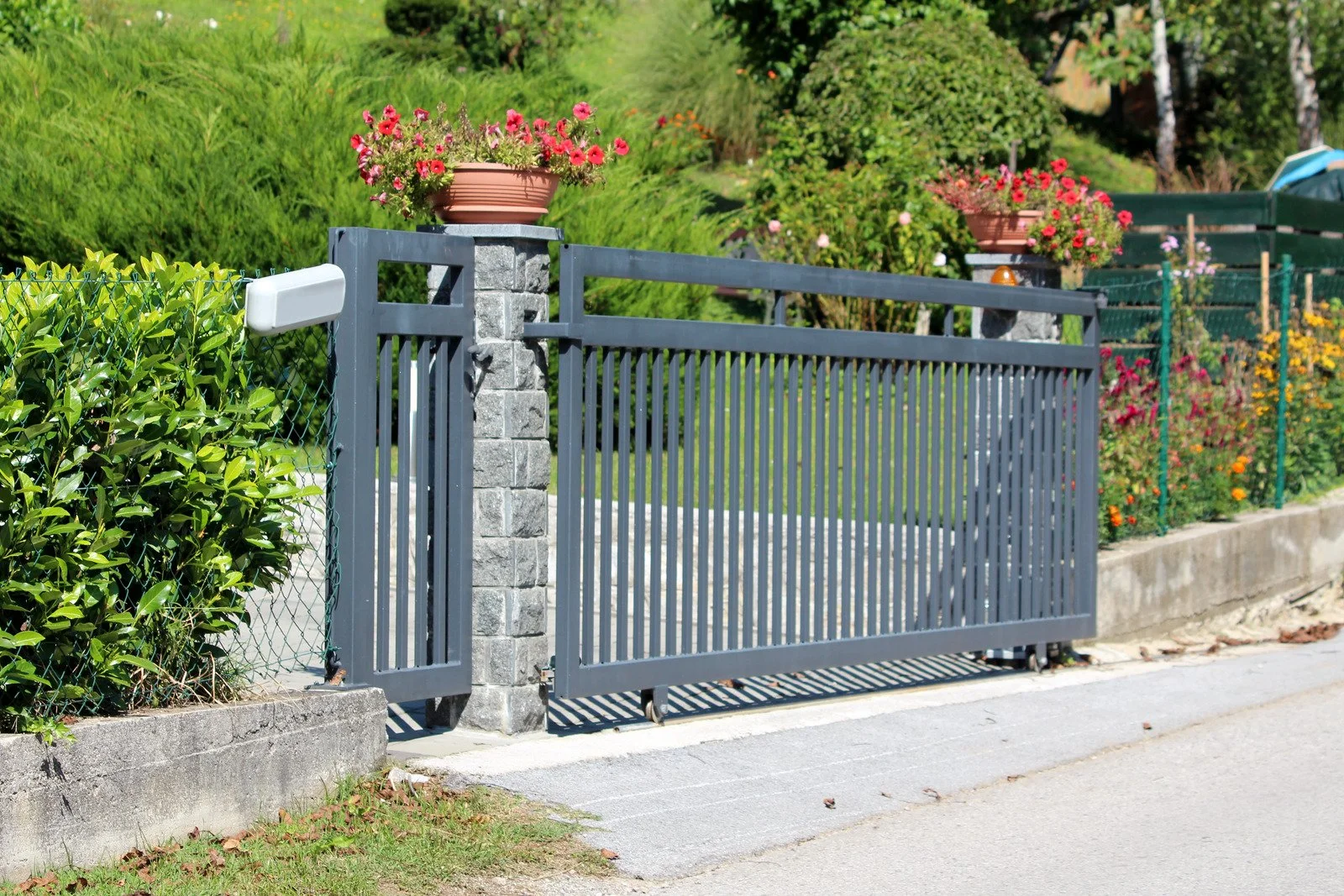
Quick Answer: A swing gate opens on hinges like a door and needs a clear arc to swing into; a slide gate rolls sideways and needs open room along the fence to retract into. Swing gates suit flat, open driveways and cost less; slide gates suit short driveways, sloped approaches, and wide openings. The deciding factors are how much room you have, whether your driveway slopes near the entrance, and how wide the opening is.
You've decided on a driveway gate, picked your iron design, and then hit the question that actually shapes the whole project: should it swing or slide? It's not a style choice — it's a geometry one. The right answer is written into your driveway: how much room sits beside and behind the opening, whether the ground rises as it meets the street, and how wide the gap is. Get that read right and the gate works for decades; get it wrong, and you're fighting the property every day.
How Each Gate Moves
A swing gate is hinged on a post and swings open like a door, either as a single panel or as a pair of panels that meet in the middle. A slide gate runs horizontally across the opening, parallel to the fence line — either rolling on a ground track or, as a cantilever, suspended just off the ground on rollers with no track at all. That difference in motion is the whole story, because each type needs open space in a different place.
The Space Each One Demands
A swing gate needs a clear arc. The panels have to swing somewhere — into the property or out toward the street — and that path has to stay clear of cars, planters, and walls. A pair of swing leaves can each sweep up to 90 degrees, so you need real estate in front of or behind the opening.
A slide gate doesn't arc, but it has to go somewhere when it opens: it retracts to the side. A tracked slide gate needs roughly 50 percent more clear width to the side than the opening itself, plus room for the motor. A cantilever slide gate, which uses a counterbalanced tail instead of a ground track, needs even more — about 1.5 times the opening width of clear run-back room, because the gate is built half again as long as the gap it covers. On a tight lot with a wall or landscaping right beside your driveway, that run-back room is often the deciding constraint.
Slope Is the Tiebreaker People Miss
If the ground rises or falls where your driveway meets the street, that usually settles it. A swing gate that opens uphill will jam against the rising grade before it's fully open; swing gates become impractical once the slope in the swing path passes roughly 10 percent. A slide gate sidesteps that because it moves parallel to the ground rather than arcing over it.
One honest caveat: a slide gate tolerates a sloped approach, but the gate's own travel path still has to be level — a cantilever gate will roll on its own if the run isn't level. So the accurate way to put it is that slide gates handle a sloped entrance far better than swing gates, as long as the strip the gate travels along is level.
| Factor | Swing gate | Slide gate |
|---|---|---|
| Space it needs | Clear arc in front or behind | Side run-back room (track 1.5x; cantilever ~1.5x opening) |
| Sloped approach | Poor above ~10% grade | Handles a sloped approach; travel path must be level |
| Very wide openings | Use dual swing | Cantilever spans wide gaps with no ground track |
| Debris/dust | Less affected | Ground tracks collect dust; cantilever avoids this |
| Upfront cost | Lower on flat, open lots | Higher (track or counterbalanced tail) |
Width, Security, and the Desert Factor
For a wide opening, a cantilever slide gate is hard to beat — it spans a large gap while hanging about six inches off the ground, with no track to bind, and it's a common choice for high-traffic entrances because there's no swing arc to work around. Dual swing gates can cover wide openings, too, if you have the arc room for two leaves.
Maintenance is where the local climate earns a mention. A ground-track slide gate collects whatever blows into it, and in the Valley that means dust and grit packing the track until it's cleared — a recurring chore. A cantilever gate skips the ground track entirely and rides on nylon rollers that don't need grease, which is one reason it suits a dusty climate. Swing-gate hinges, by contrast, need periodic greasing and can rust if neglected. And whichever you choose, the finish matters under this sun: a multi-coat powder coat is what keeps intense UV from chalking and fading the iron. The right finish is as much a part of longevity here as the gate type.
Don't Skip the Safety Standard
Any automated gate brings a safety obligation most homeowners never hear about. Gate operators are built to a national safety standard that requires at least two entrapment-protection devices for each pinch point — typically a sensor built into the operator plus an external photo eye or contact edge — and the operator is designed to stop or refuse to run if one of those devices is disconnected or faults. The gate's own construction has rules too, like screening the gap on a slide gate so a small child can't reach through or get caught. This isn't optional fine print; it's why professional installation and automation matter as much as the gate you pick.
Frequently Asked Questions
On a flat, open driveway, a swing gate is usually the lower-cost option because hinges are simpler than a track or counterbalanced cantilever system. A slide gate — especially a cantilever — costs more to build and automate. But cost shouldn't lead the decision; if your driveway slopes or lacks arc room, the cheaper gate type may not physically work, and forcing it is the real expense.
Usually not well. A swing gate that opens uphill binds against the rising grade and won't fully open once the slope in its path passes about 10 percent. On a noticeable incline, a slide gate is almost always the better choice because it moves parallel to the ground instead of arcing over the rise.
More than people expect. A tracked slide gate needs roughly 50 percent more clear space to the side than the width of the opening, plus room for the motor; a cantilever needs about 1.5 times the opening width of clear run-back room for its tail. If there's a wall or landscaping right beside your driveway, that side room is often what rules a slide gate in or out.
Slide gates have some security advantages: there's no swing arc to exploit, they suit high-traffic entrances, and solid-infill cantilever designs are hard to push through. Swing gates are perfectly secure, too, when built and automated properly. Security depends more on the gate's construction, infill, and access control than on swing-versus-slide alone.
Yes. Automated gates are governed by a safety standard that calls for multiple entrapment-protection devices — sensors and photo eyes that stop the gate if something's in the way — and construction rules like screening reach-through gaps. A properly installed gate includes these by default. It's a big reason gate automation is a job for a professional rather than a DIY add-on.
A cantilever slide gate avoids the ground track that dust and grit pack into, and rides on maintenance-light nylon rollers, which is an advantage in the desert. Swing gates avoid tracks entirely but rely on hinges that need greasing. Either lasts well with a durable powder-coat finish; the bigger enemy here is UV on a cheap finish, not the gate mechanism itself.
Let the Driveway Choose the Gate
Swing versus slide isn't about which is better in the abstract — it's about which fits the space you have. Flat and open with room to arc points to a swing gate; short, sloped, wide, or tight on arc room points to a slide. Factor in the dust and the sun, build it to the safety standard, and finish it to survive the UV, and the gate becomes the part of the property you stop thinking about because it simply works.
Trying to decide between a swing and slide gate for your driveway? — Get a site assessment that reads your space, slope, and width and recommends the right gate and finish. Sunset Gates serves Tempe and the East Valley. Call (480) 210-1572.
